
Educational Transformation and Adaptation Challenges during COVID-19 Pandemic: An Indian Scenario
Ramesh Bhandari1*
1Department of Pharmacy Practice, KLE College of Pharmacy Belagavi, KLE Academy of Higher Education and Research (KAHER), Karnataka, India
*Correspondence to: Ramesh Bhandari, Pharm.D, Assistant Professor, Department of Pharmacy Practice, KLE College of Pharmacy Belagavi, KLE Academy of Higher Education and Research (KAHER), JNMC Campus, Nehru Nagar, Belagavi, Karnataka 590010, India; Email: ramesh_2417@yahoo.com
Abstract
Because of the lockdown due to the coronavirus disease 2019 pandemic, all universities and affiliated institutions have stopped teaching-learning activities and public gatherings like workshops/conferences and postponed examinations. Various institutions in India have initiated online teaching platforms to continue the teaching-learning process during the unprecedented pandemic to overcome these situations. Various methods such as audio-visual aids, social apps like Whatsapp, and online teaching platforms like Zoom, Go-to-meeting, etc., were used for teaching-learning by different universities in India. Adaptation challenges like security issues in some online platforms, and difficulty in student learning assessment during online classes stress the fact that one education method does not fit all.
Keywords: COVID-19, education, challenges, transformation, adaptation
Novel coronavirus (nCOV) is a new strain of coronavirus[1]. Though the origin of the coronavirus disease 2019 (COVID-19) in Wuhan, China, it is spreading rapidly; declared outbreak as a pandemic by World Health Organization (WHO) on March 12, 2020[1,2]. The various countries to prevent this situation declared a lockdown and strictly adheres to the precautionary and preventive measures as per WHO.
Because of the lockdown, all universities and affiliated institutions have stopped face-to-face teaching-learning activities and public gatherings like workshops/conferences and postponed examinations. It is of utmost importance for most institutions to reach their students. Various institutions including higher education institutions in India have initiated online teaching platforms to continue the teaching-learning process during an unprecedented pandemic to overcome these situations. New learning models with new technology are interesting but troublesome to students and teachers. Technologies, in most cases, helped learn and, to a lesser extent, helped to build a student-teacher relationship during the pandemic. Online didactic lectures were conducted with the help of an online teaching platform which allows the students to discuss in real time virtually. For students having less bandwidth teachers started sharing the study materials in social sites and through websites and blogs. Few universities also adopted newer technology software for audio-visual recording of the lectures and then sharing it with the students via websites, and or social sites. In the meantime for assessing the students, online assignments and to some extent online tests were used by the universities. Figure 1 depicted the various methods used by different universities in India to continue the teaching-learning process during the COVID-19 pandemic.
|
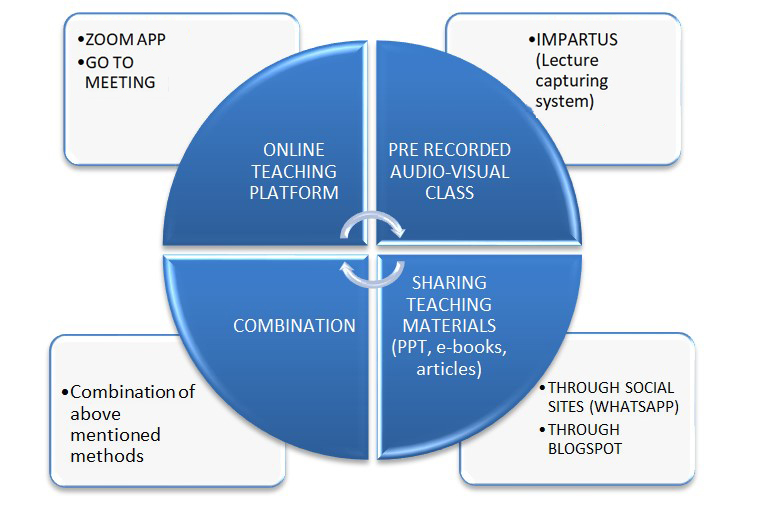
Figure 1. Methods used for teaching-learning during the COVID-19 pandemic.
Using the above methods, on average, all of them spent 2-3h of class in a day during the lockdown. Most students feel that online teaching is beneficial, and 3/4th of the students think online education is helpful in the COVID-19 situation (Based on a single-center study).
As online education begins, the problems of accessibility and affordability also increase. India is a developing country, and socioeconomically disadvantaged, and technologically challenged students are likely to face the problem of attending online classes. The lack of gadgets and lack of internet access to individual students even worsen the situation more. Flexibility in timing during online classes helped students to go along at their own pace. However, students preferred offline learning to clarify doubts because they could reach out to teachers whenever required[3]. Further, adaptation challenges like security issues in some online platforms and difficulty in student learning assessment during online classes stress that one education method does not fit all.
In the future physical (offline) and online classes can be integrated into educational institutions, which is far more effective than alone.
Virtual learning is limited by the inability to incorporate practical skills among students. Despite the fact that some universities have come up with virtual labs, their utility remains unknown due to the lack of data.
COVID-19: the reason for the transformation of education has led us to use self-directed learning. Audio-visual methods can be utilized along with face-to-face teaching in the future which will allow experiential learning for the students.
In the current scenario, the online teaching methods are by compulsion rather than by choice in the current pandemic, and the methods used are alternative methods and can be helpful along with constant support from the information technology department during COVID-19 but cannot be replaced by physical classroom teaching which is far more effective and can provide personalized education whenever required.
Acknowledgements
Not applicable.
Conflicts of Interest
The author declared no conflict of interest.
Author Contribution
The author solely contributed to the manuscript and approved the final version.
Abbreviation List
COVID-19, Coronavirus disease 2019
nCOV, Novel coronavirus
WHO, World Health Organization
References
[1] World Health Organization. WHO announces COVID-19 outbreak a pandemic, heal. emergencies 2020. Accessed May 5, 2021. Available at http://www.euro.who.int/en/health-topics/healthemergencies/coronavirus-covid-19/news/news/2020/3/who-announces-covid-19-outbreak-apandemic
[2] Sahu P. Closure of universities due to coronavirus disease 2019 (COVID-19): Impact on education and mental health of students and academic staff. Cureus, 2020; 12: e7541. DOI: 10.7759/cureus.7541
[3] Aditi S. Legal analysis of online education. Accessed May 5, 2021. Available at https://articles.manupatra.com/article-details/Legal-Analysis-of-Online-Education
Copyright © 2023 The Author(s). This open-access article is licensed under a Creative Commons Attribution 4.0 International License (https://creativecommons.org/licenses/by/4.0), which permits unrestricted use, sharing, adaptation, distribution, and reproduction in any medium, provided the original work is properly cited.


 Copyright ©