
Transient Expression of Plant-Codon-Optimized Cry2ab39 Gene by Agroinfiltration in N. Benthamiana
Ngoc Thu Le1,2, Huyen Thi Tran1, Vy Thai Trinh1, Tra Thi Nguyen1, Ha Hoang Chu1,2, Phat Tien Do1,2*, Thanh Minh Thi Le1, Ngoc Bich Pham1,2*
1Institute of Biotechnology, Vietnam Academy of Science and Technology, Hanoi, Vietnam
2Graduate University of Science and Technology, Vietnam Academy of Science and Technology, Hanoi, Vietnam
*Correspondence to: Phat Tien Do, PhD, Head, Vietnam Academy of Science and Technology, 18 Hoang Quoc Viet, Cay Giay, Hanoi 13111, Vietnam; Email: dtphat@ibt.ac.vn
Ngoc Bich Pham, Vietnam Academy of Science and Technology, 8 Hoang Quoc Viet, Cay Giay, Hanoi 13111, Vietnam; Email: pbngoc77@gmail.com
Abstract
Objective: This study was performed to modify the coding sequence of a novel Cry2Ab39 gene derived from B. thuringiensis serovar canadensis strain SP142 in Vietnam and investigate the expression of this codon-optimized gene in Nicotiana benthamiana (N. benthamiana) leaves.
Methods: The Cry2Ab39 gene sequence (Genebank No. MN319700.1) was modified based on codon bias of N. benthamiana. A sequence coding the legumin B4 signal peptide and a His-tag coding sequence followed by endoplasmic reticulum (ER) retention signal KDEL were added to the 5' and 3' ends of the codon optimized Cry2Ab39 gene, respectively. The binary vector pFGC5941 harboring optimized Cry2Ab39 under the control of either CaMV 35S or Arabidopsis rbcS1A promoters was constructed and used for transient gene expression in N. benthamiana via agroinfiltration.
Results: The native Cry2Ab39 gene were optimized based on codon usage of N. benthamiana along with a preference of G/C-containing codons to increase the overall G-C content and the potential mRNA stability sequences. A significantly higher Cry2Ab39 protein quantity was produced from the construct driven by the Arabidopsis rbcS1A promoter as compared to the CaMV 35S promoter. In addition, the highest recombinant protein was accumulated in tobacco leaves at 6 days-post-infiltration (dpi) with bacterial density OD600 of 0.5. The His-tagged Cry2Ab39 was successfully purified by affinity chromatography using Ni-NTA columns.
Conclusion: The recombinant Cry2Ab39 protein was successfully produced and purified from N. benthamiana leaves in appropriate amounts using suitable promoters and optimal transformation parameters. These results suggest high production of codon-optimized Cry2Ab39 gene in the plant system and show its potential for further applications in creating insect resistant crops.
Keywords: Agroinfiltration, codon optimization, Cry2Ab39 gene, recombinant protein, tobacco
1 INTRODUCTION
Bacillus thuringiensis (Bt) is a Gram-positive, endospore-forming soil bacterium and can be isolated from diverse habitats, including soil, water, plants, insects, stored-product dust[1-3]. Its parasporal inclusion bodies are well-known as insecticidal crystal proteins (or δ-endotoxins), including crystal (Cry) and cytolytic toxins at the onset of sporulation and non-crystalline toxins (Vip and Sip proteins) during the vegetative growth phase[4,5]. These proteins are toxic against a number of insect species from different orders such as Lepidoptera, Coleoptera, Diptera, Hymenoptera, Homoptera, Mallopphaga, and other organisms, i.e., Nematodes[6,7]. Among Bt insecticidal proteins, Cry toxins were most widely employed in insect management either as biopesticidesor pest-resistant transgenic plants through genetic engineering[8]. Genes coding Cry proteins mostly locate in large plasmids in Bt bacteria[9]. Up to now, 75 different Cry toxin groups (Cry1 to Cry75) have been found with more than 800 members[10].
The rapid discoveries of Bt genes in conjunction with advances in transgenic technology have promoted the generation of Bt crops resistant to pests on a global scale[11,12]. The genes of cry1-type were the most popular source for production of the first-generation Bt crops. However, due to long-term use and large-scale cultivation, target insects were escaped from these toxins due to the evolution of resistance[13-15]. Therefore, Cry2A toxins currently are alternative candidates for production of second-generation transgenic plants to control insect pests instead of Cry1-type toxins. The Cry2A toxin family (65-70kDa proteins) formed cuboidal crystals in B. thuringiensis strains and actively targeted lepidopteran as well as dipteran insects[16]. One important note is that Cry2A proteins were found to be lethal to some lepidopteran pests, which were unaffected by Cry1 toxins[17]. Furthermore, with different receptors on brush border membrane vesicles, those toxins exhibited the low level of cross-resistance in Cry1-resisitant insects[18,19]. In addition, due to their smaller molecular size than Cry1 genes, the genes encoding Cry2A toxins are thought to have greater advantages for transformation as well as expression in plants[20]. In this regard, research for new Cry2A-type toxins with high insecticidal activity and wide spectrum of toxicity seems an attractive approach not only for the development of transgenic plants to control crop pests but also the management of insect resistance evolution.
The challenge in development of Bt transgenic crops is the efficient and stable expression and translation of insecticidal genes and toxic protein in plant cells[21,22]. Initial attempts to introduce native Bt genes into transgenic plants resulted in extremely low levels of mRNAs and the corresponding proteins which were insufficient for protection of the crops from target insects[23]. Codon optimization of bacterial genes based on codon usage of host plants was proved as one of the efficient ways to solve this issue. Synthetic Bt genes with modification in coding sequences were found to be expressed with the high efficiency in host plants and conferred insect resistance of the hosts[22,24-26].
In our previous work, the novel gene Cry2Ab39 derived from B. thuringiensiss erovar canadensis strain SP142 isolated in Vietnam was characterized and its toxicity was evaluated (data not published yet). In this study, the Cry2Ab39 codon sequence was optimized for transient expression in N. benthanmia via agroinfiltration method. Different transformation parameters as well as promoters were evaluated to improve expression and accumulation of the Cry2Ab39 protein in tobacco leaf tissue. The recombinant Cry2Ab39 was successfully purified using affinity chromatography via Ni-NTA columns. Our results provide strategies for expression and production of bacterial proteins in plant systems. In addition, the codon-optimized Cry2Ab39 gene is potential for further researches to create insect resistant crops.
2 MATERIALS AND METHODS
2.1 Plasmids, Bacteria and Plant Materials
The vector pBT/At-rbcs1Aprocarrying Arabidopsis rbcs1A promoter (provided by Plant Cell Biotechnology Lab., Institute of Biotechnology, VAST, Vietnam) and the binary vector pFGC5941 (Addgene, USA, #44182) were used to construct the plant expression vectors. pBI121/35S_Hc-Pro PVY, a pBI121-based expression vector for the production of helper component-proteinase (HcPro) of Potato virus Y (a gift from Applied DNA Technology Lab., Institute of Biotechnology, VAST, Vietnam), 4-week hydroponic N. benthamiana plants and the Agrobacterium tumefaciens strain AGL1 (purchasedfrom Nova Lifetech, Hongkong) was used for transientexpression experiments.
2.2 Codon Modification and Gene Synthesis
Based on the codon usage database for N. benthamiana (https://www.kazusa.or.jp/codon/cgi-bin/showcodon.cgi?species=4100)[27], rare codons (below 20%) in coding sequence of the wild-type Cry2Ab39 gene (Genebank No. MN319700.1) were eliminated and edited to expected codons without changing the amino acid sequence. The web-based tool Seqool (http://www.biossc.de/seqool/index.html) was used to find AT-rich regions, potential plant polyadenylation signal sequences as well as sequence motifs known as triggers of RNA instability in plants[28]. These sequences were then manually substituted by degenerate codons. In addition, the mRNA secondary structure was analyzed using NUPACK66 software (http://www.nupack.org) to eliminate the stable loop structure formation. In order to translocate this insecticidal protein to the endoplasmic reticulum (ER), the legumin B4 signal peptide and ER retention signal (KDEL) were fused to the N and C termini of the optimized Cry2Ab39 gene, respectively. The His-tag coding sequence and NcoI and SmaI cloning sites were added to C-terminal region and the 5’ and 3’ ends of the modified Cry2Ab39 gene, respectively to facilitate protein purification procedure. The codon-optimized Cry2Ab39 was synthesized by GenScript (Hong Kong) and cloned into pUC57 cloning vector.
2.3 Vector Construction
The full-length Cry2Ab39 gene was obtained from cloning vector pUC57/Cry2Ab39 using NcoI and XmaI (Thermo Scientific, USA), and then mobilized into the binary vector pFGC5941 backbone to generate pFGC5941/35S_Cry2Ab39. The 35S promoter of the pFGC5941/35S_Cry2Ab39 vector was replaced with the At-rbcS1A promoter obtained by digesting pBT/At-rbcS1Spro using EcoRI and XhoI (Thermo Scientific, USA) to produce the second vector, pFGC5941/At-rbcS1A_Cry2Ab39. The two plasmids were introduced individually into Agrobacterium tumefaciens strain AGL1 using freeze-thaw method[29].
2.4 Agroinfiltration
The expression of the recombinant protein in plant by agroinfiltration was conducted as described by Ho et al.[30] with optimization. Briefly, a single colony of AGL1 straincarrying Cry2Ab39 or Hc-Pro (an RNA silencing suppressor that prevents degradation of T-DNA transcripts[31,32]) expression constructs were cultured in 200mL of LB medium containing appropriate antibiotics in the 200rpm shaker (MaxQ 6000, Thermo Fisher, USA) at 28°C for 14-16h to reach optical density at 600nm (OD600) of 1.8 (measured using Beckman Coulter DU800 spectrophotometer, USA). Bacterial cells were harvested and resuspended in the infiltration buffer (10mM 2-(N-morpholino) ethanesulfonic acid, 10mM MgSO4, pH 5.6) to get the final OD600 of 0.5. Equal volumes of two bacterial suspensions were combined and used for infiltration.Whole plants of N. benthamiana were placed upside down in the bacterial mixture inside a desiccator under the vacuum of 40Torr for 2min. After infiltration, the plants were returned to the greenhouse at 21℃ with 16/8h light and dark photoperiod. Leaf samples were collected at 5 days-post-infiltration (dpi) and stored at -80℃ for further analysis. Different factors including gene constructs (pFGC5941/35S_Cry2Ab39, pFGC5941/At-rbcS1A_Cry2Ab39), Agrobacterium density (OD600=0.1, 0.3, 0.5, 0.8) and leaf harvesting time (1, 2, 3, 4, 5, 6, 7dpi) were evaluated to reveal the optimal conditions for production of recombinant Cry2Ab protein in tobacco leaves. The expression of the target protein was assessed through Western blot analysis, and the optimal conditions were employed in large-scale to produce Cry2Ab39 for the subsequent purification experiments.
2.5 SDS-PAGE and Western Blot
Leaf samples were ground in liquid nitrogen and homogenized in PBS buffer (137mM NaCl, 2.7mM KCl, 10mM Na2HPO4, 1.8mM KH2PO4, pH 7.4) at a 1:3 (w/v) ratio. The raw extracts were centrifuged at 13,000rpm (Sorvall legend micro21 microcentrifuge, Thermo Scientific, USA), 4°C for 30min to remove cell mass. The total soluble protein contents were determined by Bradford assay[33] with bovine serum albumin (Sigma-Aldrich) as a standard. The extracted proteins were then diluted to the final concentration of 3µg/µL. About 30µg total protein of each sample was subjected to glycine SDS-polyacrylamide gel electrophoresis (SDS-PAGE) according to the description of Laemmli[34]. The SDS-PAGE gel was stained for 30min with 0.2% (w/v) Coomassie Brilliant Blue R-250 (Merck, Germany) in a mixture of methanol/acetic acid (40:10, v/v). Western blot procedure was carried out using monoclonal anti-6X His tag antibody following the protocol described by Pham et al. (2019)[31].
2.6 Protein Purification
Cry2Ab39 protein expressed in N. benthamiana was purified using immobilized metal ion affinity chromatography (IMAC) which is designed for purification of 6xHis-tagged recombinant proteins. One hundred grams of tobacco leaves were ground in liquid nitrogen and blended in 300mL of binding buffer (20mM NaH2PO4, 0.5M NaCl, 20mM imidazole, pH 8.0). The crude extract was centrifuged twice at 13,000rpm, 4°C for 30min to clarify the cell lysate. The supernatant was subsequently incubated with 10 mL of Ni-NTA resin (Cube Biotech, Germany) equilibrated in binding buffer and mixed gently at 4°C for an hour to allow affinity binding with Cry2Ab. The protein/resin complex was applied to a Econo-Pac chromatographycolumn (Bio-Rad 7321010) and extensively washed with a washing buffer (20mM NaH2PO4, 0.5M NaCl, 40mM imidazole, pH 8.0) to remove the unbound nonspecific proteins. Recombinant protein Cry2Ab39 was finally eluted from the column using an elution buffer (20mM NaH2PO4, 0.5M NaCl, 500mM imidazole, pH 8.0). One-milliliter fractions were collected separately in microcentrifuge tubes and SDS-PAGE assay was carried out to analyze the purity of protein samples. The fractions containing purified protein were then pooled for dialysis against PBS to remove the imidazole and finally concentrated using the 3K MWCO protein concentrator column (Thermo Scientific, USA). Protein concentration was determined using the Bradford assay[33].
3 RESULTS
3.1 Cry2ab39 Codon Optimization and Synthesis
The proper expression of insecticidal genes in plant cells is a critical factor required for the insect resistance of transgenic crops[35]. Thus, in this study, the native Cry2Ab39 gene sequence was optimized for expression in N. benthamiana with a preference of G/C-containing codons to increase the overall G-C content. Furthermore, ATTTA motifs as messenger destabilization elements and potential poly A signal sites (AATATT, AATTAA, AATAAA and AATAAT) as well as predicted potential splice sites were eliminated. In addition, the RNA secondary structure was removed and RNA instability motifs were avoided. As a result, the optimized sequence differed from the original one by 24.15% at the nucleotide level, but no change in the amino acid sequence. In addition, the GC content of the codon-optimized sequence increased to 45.1%. Importantly, the sequences conferring potential mRNA secondary structures as well as mRNA destabilization and splicing were eliminated (Table 1).
Table 1. Comparison of the Original and Optimized Cry2Ab39 Gene
Parameter |
Original Cry2Ab39 |
Optimized Cry2Ab39 |
||||
Base |
No. of Bases |
Percentage (%) |
Base |
No. of Bases |
Percentage (%) |
|
Base content |
A |
661 |
32.45 |
A |
573 |
28.13 |
|
T |
659 |
32.35 |
T |
626 |
30.73 |
|
G |
368 |
18.07 |
G |
414 |
20.32 |
|
C |
349 |
17.13 |
C |
424 |
20.81 |
GC% |
35.2% |
45.1% |
||||
RNA instability motifs |
76 |
0 |
||||
RNA secondary structure |
12 |
0 |
||||
3.2 Plant Transient Vector Construction
To evaluate the influence of the constitutive CaMV 35S promoter and At-rbcS1A promoter on Cry2Ab39 expression in tobacco, pFGC/35S_Cry2Ab39 and pFGC/At-rbcS1A_Cry2Ab39 were constructed (Figure 1A), respectively. The pFGC/35S_Cry2Ab39 vector was created by subcloning of the Cry2Ab39 gene (2037bp) digested from pUC57/Cry2Ab39 into pFGC5941 at NcoI and XmaI sites (Figure 1B, lanes 1 and 2). Restriction analysis ofthe recombinant vector pFGC/35S_Cry2Ab39 by NcoI-XmaI (Figure 1B, lane 3) exhibited the expected fragment of 2037bp corresponding to Cry2Ab39 as well as the presence of 10-kbvector backbone, indicating the vector successful designed. The latter construct was built based on the former by replacing the 35S promoter with At-rbcs1A promoter. Both pFGC/35S_Cry2Ab39 and pBT/At-rbcs1Apro were first treated by EcoRI-XhoI (Figure 1B, lanes 4 and 5). The fragments of At-rbcs1A promoter(1100bp) and digestedbackbone vector (10.6kb) were ligated to generate pFGC/At-rbcS1A_Cry2Ab39 (Figure 1B, lane 6). Both constructed expression vectors were then introduced into Agrobacterium for plant transformation.
|
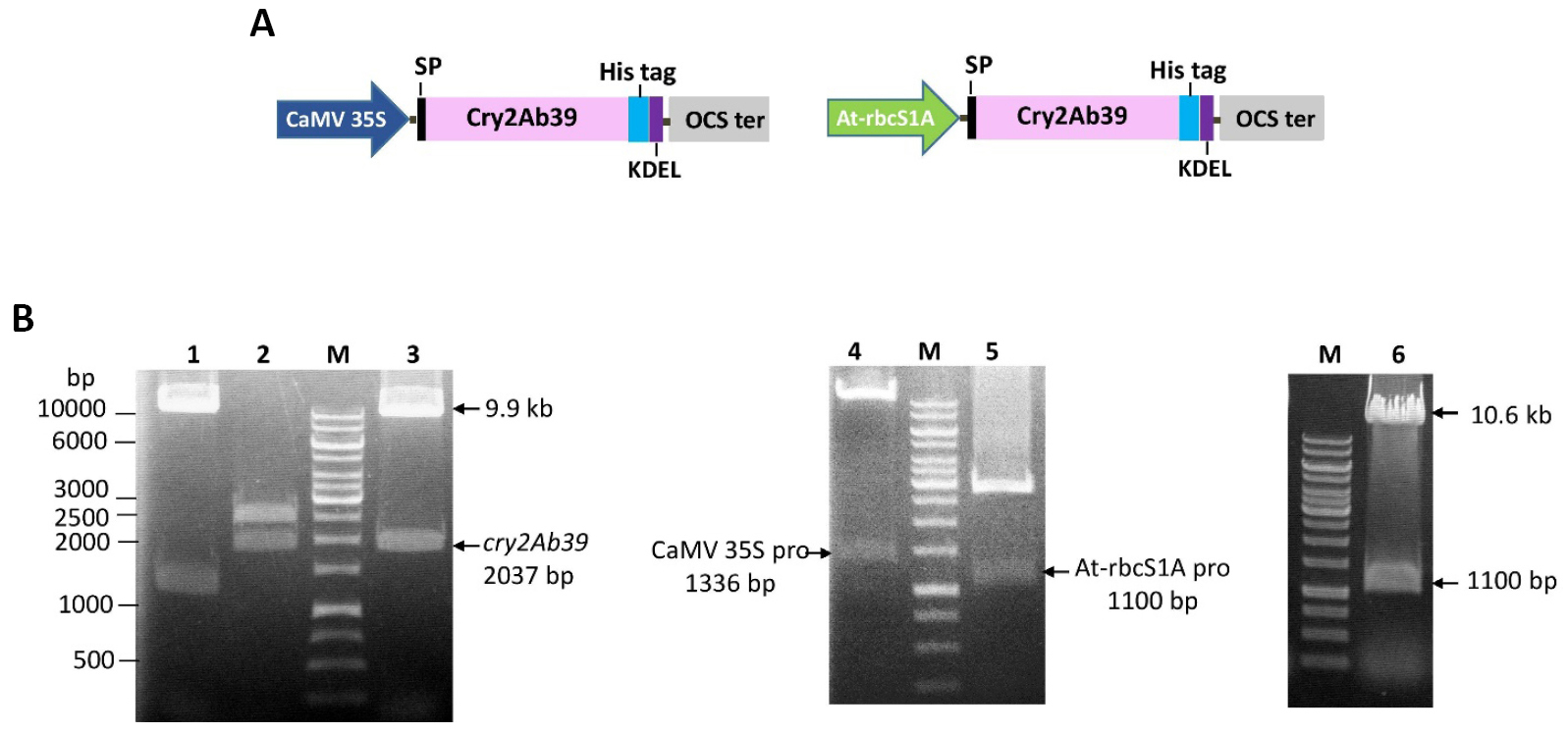
Figure 1. Plant transformation vector construction for Agrobacterium infiltration. A: Cry2Ab29 expression cassettes regulated by either CaMV 35S promoter or At-rbcS1A promoter. SP: LeB4 signal peptide. KDEL: ER retention signal. OCS ter: octopine synthase terminator. His tag: six histidine (6xHis) residues; B: Clonning procedure to mobilize Cry2Ab39 gene into pFGC5941 expression vector. Lanes 1 and 2: digestion of pFGC5941 and pUC57/Cry2Ab39 using NcoI and XmaI, respectively. Lanes 4 and 5: digestion of pFGC/35S_Cry2Ab39 and pBT/At-rbcS1A using EcoRI and XhoI, respectively. Lanes 3 and 6: Confirmation of recombinant vectors pFGC/35S_Cry2Ab39 and pFGC/At-rbcS1A_Cry2Ab39 by treatment with NcoI-XmaI and EcoRI-XhoI, respectively. M: DNA ladder 1kb (Thermo Scientific, USA).
3.3 Transient Expression of Cry2Ab39 in Nicotiana Benthamiana
3.3.1 Effects of Promoters
The efficiency of the constitutive CaMV 35S promoter and Arabidopsis rbcS1A promoter on transient expression of Cry2Ab39 was evaluated using the tobacco agroinfiltration system. The total protein contents of crude extracts from infiltrated tobacco leaves of each construct were analyzed by Western blot using anti-6X His antibody (Figure 2A). The expected protein band with a size of nearly 75kDa representing the recombinant his-tagged Cry2Ab39 was detected in leaf samples infiltrated with both designed constructs, but absent in the negative control. A significantly higher Cry protein content was observed from the pFGC/At-rbcS1A_Cry2Ab39 construct as compared to pFGC/35S_Cry2Ab39 based on protein band intensity. This result indicated that the At-rbcS1A promoter is more effective for transient expression of Cry2Ab39 gene in N. benthamiana leaves.
|

Figure 2. Optimization of transient expression of Cry2Ab39 in N. benthamiana. A: Effect of different promoters (CaMV 35S and At-rbcS1A) on recombinant Cry2Ab39 production in tobacco. The leaves (3 plants per construct) were infiltrated with A. tumefaciens strain AGL1 harboring either one of the two constructs at OD600=0.5. Equal amounts of total soluble protein extracted from 5dpi leaves were transferred to PVDF membrane and probed with anti-6xHis antibody; B: Optimization of bacterial concentrations for agroinfiltration. The leaves (2 plants per bacterial density) were infiltrated with A. tumefaciens strain AGL1 harboring pFGC/At-rbcS1A_Cry2Ab39 at different concentrations (OD600=0.1, 0.3, 0.5 and 0.8). Equal amounts of total soluble protein extracted from 5dpi leaves were transferred to PVDF membrane and probed with anti-6xHis antibody; C: Optimization of harvest time. Tobacco leaves were infiltrated with A. tumefaciens strain AGL1 harboring pFGC/At-rbcS1A_Cry2Ab39 at OD600=0.5. Equal amounts of total soluble protein extracted from leaves at 1, 2, 3, 4, 5, 6 and 7dpi were transferred to PVDF membrane and probed with anti-6xHis antibody. PC (positive control): Thioredoxin-fused Cry2Ab39 (Trx-Cry2Ab39) expressed in E. coli BL21 (89kDa). NC (negative control): WT plants. M: Prestained Protein Ladder (10 to 180kDa,Thermo Scientific).
3.3.2 Effect of Bacterial Density
To find an optimal bacterial density for Cry2Ab39 transient expression in N. benthamiana leaves, the suspension of Agrobacterium AGL1 strain harboring pFGC/At-rbcS1A_Cry2Ab39 was prepared at final densities (OD600) of 0.1 to 0.8. Samples were collected at 5dpi and recombinant protein levels were assessed by Western blot. According to data on the Figure 2B, the highest efficiency of Cry2Ab39 production was achieved at OD600=0.5. However, the Cry2Ab39 protein was not detectable from the treatment of OD600=0.1. This result indicated that the bacterial suspension at OD600=0.5 was suitable for transient expression of Cry2Ab39 in tobacco via agroinfiltration.
3.3.3 Effect of Harvest Time
Cell suspension of A. tumefaciens strain AGL1 carrying pFGC/At-rbcS1A_Cry2Ab39 adjusted to OD600=0.5 was used for tobacco leaf infiltration. Recombinant protein was extracted from leave samples collected at 1, 2, 3, 4, 5, 6, 7dpi. Cry2Ab39 concentration was semi-quantified by Western blot (Figure 2C). Densitometry analysis of the protein bands showed that the expression of recombinant Cry2Ab39 were detectable from 2dpi. The protein concentrations increased gradually and reached the highest level at 6dpi, then dramatically decreased. Therefore, 6dpi was selected for sample harvesting to obtain the highest desired protein content.
3.4 Purification of Recombinant Cry2Ab39
In this work, we used IMAC Ni-NTA under native conditions to purify His-tagged recombinant Cry2Ab39 from crude extract of tobacco leaves. The SDS-PAGE and Western blot analysis of different fractions collected during the whole process presented in Figure 3 demonstrated the successful purification of the target protein in expected size (75kDa). The non-specific binding of contaminant proteins rich in histidine was reduced by adding low concentration of imidazole to binding and wash buffers. The purified recombinant protein was obtained with the purity greater than 90%, and purification yield was estimated about 1.5g protein per kg fresh weight of leaves.Therefore, using this method, Cry2Ab39 protein was purified from tobacco leave extract with the high purity and concentration.
|
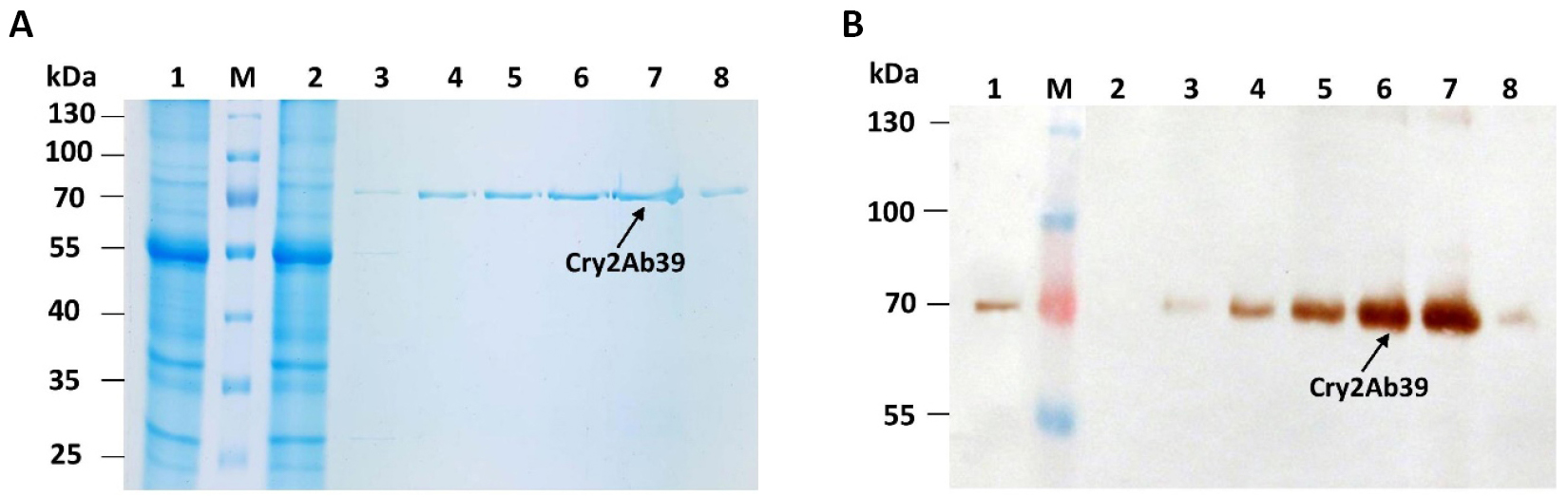
Figure 3. Purification of recombinant Cry2Ab39. A and B: SDS-PAGE (A) and Western blot (B) analysis of native purification of Cry2Ab39. Lane 1: raw extract of tobacco leaves. Lane 2: flow-through. Lanes 3 to 8: Fractions of eluted protein from Ni-NTA column. M: Prestained protein ladder (Thermo Scientific).
4 DISCUSSION
4.1 Plant Codon Optimization of Cry2ab39 Gene Sequence
In many studies, bacterial Cry genes were poorly expressed in plants and could not help plants to protect themselves from relevant pests[23]. A major reason for the low-level expression of bacterial Cry genes in plant cells is that their mRNA transcripts are extremely unstable and degraded rapidly. The causes of the mRNA instability were a distinct difference in the DNA composition between bacterial Cry genes and plant genes. The A-T percentage of wild-type Cry genes is much higher than in a typical plant gene. These A-T-rich regions in bacterial genes might resemble plant introns or potential plant polyadenylation signal sequences and therefore cause premature termination of translation and subsequent degradation of the target mRNA[24,35-37]. In addition, different preferences in codon usage of plant and bacterial systems lead to ineffective translation[35,37]. In our study, five strategies of optimization were employed to enhance protein expression: (1) minimizing rare codons for tobacco by preferred codon substitution; (2) increasing the frequencies of GC-rich codons to upper the overall GC-content of the whole gene; (3) eliminating potential splice sites as well as polyA addition signal sequences; (4) avoiding RNA secondary structures and RNA instability motifs; (5) translocating the recombinant protein to the ER by addition of a signal peptide and ER retention signal sequence. The purification result showed that expression level of the insecticidal protein in leaf tissues was about 1.5μg/g, which is equal or higher than those of other previous reports[38,39], suggesting effective codon optimization.
4.2 Potential Promoter for Cry2ab39 Gene Expression in Tobacco Leaves
Regulation of transgene transcription is one of the critical steps in recombinant protein production. Promoter is a key regulatory element responsible for direct control of the transcription initiation process and can explain up to 80% variance of corresponding protein level in host cells[40]. Thus, a suitable promoter is required for optimum gene expression[41]. In this work, effects of the two promoters, CaMV35S and Arabidopsis rbcS1A, on Cry2Ab39 transient expression were investigated. The former is generally considered as a strong constitutive promoter and commonly used for high-level production of recombinant protein in plant cells[42], while the latter is a tissue-specific promoter for overexpression of transgenes in leaves and green fruits[43,44]. Recombinant protein quantification by Western blot showed that Cry2Ab39 content in tobacco leaf tissuesunder the direction of At-rbcS1A promoter was significantly higher than that driven by CaMV35S promoter (Figure 2A), suggesting the superior effectiveness of At-rbcS1A. This is also proof of the fact that strong promoters are not always good choices for overexpression of recombinant proteins. In some situations, the utilization of a very strong promoter to drive the transgenes not only results in accumulation of target mRNAs in the cytoplasm, but also contributes to increase the amount of aberrant RNAs that might trigger post-transcriptional silencing[45,46], ultimately leading to loss of production yield. Furthermore, green-tissue-specific expression using rbcS promoters was proposed to be an efficient approach to improve transgene expression level in plant systems[47-49].
4.3 Optimal Conditions for Cry2ab39 Protein Production in Tobacco Leaves
Agroinfiltration is a simple but effective tool to deliver heterologous genes into plant cells and rapid to product recombinant proteins[50]. Although this method has been used extensively on leaf tissue of N. benthamiana[51-54], depending on the target genes, several factors need to be examined to enhance Agrobacterium infection into leaf tissues and increase protein yields. In our study, cell density of bacterial inoculum and harvest time were found to be significant effect to the expression of Cry2Ab39. Bacterial density for agroinfiltration was reported as one of the factors affecting transformation efficiency and subsequent transient expression of recombinant proteins[50,55,56]. Over diluted bacterial suspension may result in a low bacteria/target cell ratio, thereby decreasing transformation frequencies, whereas concentrated bacterial cultures may cause bacterial overgrowth which leads to excessive tissue damage[50,57]. Among tested OD600 of Agrobacterium suspension, the highest expression level of Cry2Ab39 was observed at OD600=0.5 (Figure 2B). Agrobacterium cell density OD600=0.5 was also used for infiltration in many previous studies to obtain maximum transient expression efficiency of recombinant proteins in N. benthamiana[58-60]. A part from bacterial density, the leaf harvesting time after infection also affect the transient expression level of recombinant proteins[61]. Accordingly, agroinfiltrated leaves should be collected when they showed the least damage by Agrobacterium infiltration (i.e., chloroplasts loss such aschlorosis, necrosis, and wilting). The cellular damage can affect energy-generating capacity and therefore reduce protein production. As observed in our data (Figure 2C), 6dpi was the best time for obtaining recombinant protein Cry2Ab39. According to previous studies, the optimal harvest time for transient expression via agroinfiltration depended on the host plants and Agrobacterium strains used for transformation as well as individual introduced recombinant proteins[50,62].
5 CONCLUSION
In this study, anovel bacterial Cry2Ab39 gene was codon optimized and constructed for expression in N. benthamiana leaves via Agrobacterium infiltration method. The recombinant Cry2Ab39 protein was successfully produced and purified from this plant expression system using suitable promoters and optimal transformation parameters. Although the toxicity of the recombinant protein needs to be validated, the designed construct with the codon optimized Cry2Ab39 gene is potential for further researches to create insect resistant crops.
Acknowledgements
This research is funded by the project “Isolation and design of the resistance genes to create genetically modified soybean (2017-2020)”, belonging to the key program on biotechnology Development and application in the Vietnam Agriculture and Rural Development by 2020, MARD. Authors would like to thank Dr. Van Tuong Nguyen for great discussion and proofreading of the manuscript.
Conflicts of Interest
The authors declared no conflict of interest.
Author Contribution
Chu HH supervised the study. Pham NB and Le LMT designed the experiments and reviewed the entire manuscript. Le NT performed gene optimization, vector construction and protein analysis. Trinh VT, Nguyen TT and Tran HT conducted agroinfiltraion. Le NT wrote the main manuscript. Do PT provided proofreading and revising the manuscript.
Abbreviation List
Bt, Bacillus thuringiensis
Cry, Crystal
Cyt, Cytolytic
dpi, Days-post-infiltration
ER, Endoplasmic reticulum
HcPro, Helper component-proteinase
IMAC, immobilized metal ion affinity chromatography
KDEL, Endoplasmic reticulum retention signal
LeB4, Legumin B4
N. Benthamiana, Nicotiana benthamiana
OD600, Optical density at 600nm
SDS-PAGE, SDS-polyacrylamide gel electrophoresis
References
[1] Höfte H, Whiteley HR. Insecticidal crystal proteins of Bacillus thuringiensis. Microbiol Rev, 1989; 53: 242-255. DOI: 10.1128/mr.53.2.242-255.1989
[2] Knowles BH, Dow JAT. The crystal δ-endotoxins of Bacillus thuringiensis: Models for their mechanism of action on the insect gut. BioEssays, 1993; 15: 469-476. DOI: 10.1002/bies.950150706
[3] Roh JY, Choi JY, Li MS et al. Bacillus thuringiensis as a specific, safe, and effective tool for insect pest control. J Microbiol Biotechnol, 2007; 17: 547-559.
[4] Crickmore N, Zeigler D R, Feitelson J et al. Revision of the nomenclature for the Bacillus thuringiensis pesticidal crystal proteins. Microbiol Mol Biol R, 1998; 62: 807-813. DOI: 10.1128/MMBR.62.3.807-813.1998
[5] Palma L, Muñoz D, Berry C et al. Bacillus thuringiensis toxins: an overview of their biocidal activity. Toxins (Basel), 2014; 6: 3296-325. DOI: 10.3390/toxins6123296
[6] Bravo A, Pacheco S, Gómez I et al. Insecticidal Proteins from Bacillus thuringiensis and Their Mechanism of Action. In: Bacillus Thuringiensis and Lysinibacillus Sphaericus. Fiuza L, Polanczyk R, Crickmore N ed. Springer: Cham, Germany, 2017. DOI: 10.1007/978-3-319-56678-8_4
[7] Saleem F, Shakoori AR. The First Cry2Ac-Type Protein Toxic to Helicoverpa armigera: Cloning and Overexpression of Cry2ac7 Gene from SBS-BT1 Strain of Bacillus thuringiensis. Toxins (Basel), 2017; 9: 358. DOI: 10.3390/toxins9110358
[8] Heckel DG. How do toxins from Bacillus thuringiensis kill insects? An evolutionary perspective. Arch Insect Biochem Physiol, 2020; 104: e21673. DOI: 10.1002/arch.21673
[9] Jara S, Maduell P, Orduz S. Diversity of Bacillus thuringiensis strains in the maize and bean phylloplane and their respective soils in Colombia. J Appl Microbiol, 2006; 101: 117-124. DOI: 10.1111/j.1365-2672.2006.02901.x
[10] Azizoglu U. Bacillus thuringiensis as a Biofertilizer and Biostimulator: a Mini-Review of the Little-Known Plant Growth-Promoting Properties of Bt. Curr Microbiol, 2019; 76: 1379-1385. DOI: 10.1007/s00284-019-01705-9
[11] Abbas MST. Genetically engineered (modified) crops (Bacillus thuringiensis crops) and the world controversy on their safety. Egypt J Biol Pest Co, 2018; 28: 1-12. DOI: 10.1186/s41938-018-0051-2
[12] Xiao Y, Wu K. Recent progress on the interaction between insects and Bacillus thuringiensis crops. Philosophical Transactions of the Royal Society B, 2019; 374: 20180316. DOI: 10.1098/rstb.2018.0316
[13] Akhurst RJ, James W, Bird LJ et al. Resistance to the Cry1Ac delta-endotoxin of Bacillus thuringiensis in the cotton bollworm, Helicoverpa armigera (Lepidoptera: Noctuidae). J Econ Entomol, 2003; 96: 1290-1299. DOI: 10.1603/0022-0493-96.4.1290
[14] Wang P, Zhao JZ, Rodrigo-Simón A et al. Mechanism of Resistance to Bacillus thuringiensis Toxin Cry1Ac in a Greenhouse Population of the Cabbage Looper, Trichoplusia ni. Appl Environ Microbiol 73, 1199-1207. DOI: 10.1128/AEM.01834-06
[15] Walsh T, James B, Chakroun M et al. Isolating, characterising and identifying a Cry1Ac resistance mutation in field populations of Helicoverpa punctigera. Sci Rep, 2018; 8: 2626. DOI: 10.1038/s41598-018-21012-w
[16] Sevim A, Eryüzlü E, Demirbağ Z et al. A Novel cry2Ab Gene from the Indigenous Isolate Bacillus thuringiensis subsp. kurstaki. J Microbiol Biotechnol, 2012; 22: 133-40. DOI: 10.4014/jmb.1108.08061
[17] Yamamoto T, Powell GK. Bacillus thuringiensis Crystal Proteins Recent Advances in Understanding its Insecticidal Activity. In: Advanced Engineered Pesticides. Kim L ed. Marcel Dekker: New York, USA, 1993.
[18] Elleuch J, Jaoua S, Ginibre C et al. Toxin stability improvement and toxicity increase against Dipteran and Lepidopteran larvae of Bacillus thuringiensis crystal protein Cry2Aa. Pest Manag Sci, 2016; 72: 2240-2246. DOI: 10.1002/ps.4261
[19] Gouffon C, Van Vliet A, Van Rie J et al. Binding sites for Bacillus thuringiensis Cry2Ae toxin on heliothine brush border membrane vesicles are not shared with Cry1A, Cry1F, or Vip3A toxin. Appl Environ Microbiol, 2011; 77: 3182-3188. DOI: 10.1128/AEM.02791-10
[20] Hire RS, Makde RD, Dongre TK et al. Expression, purification and characterization of the Cry2Aa14 toxin from Bacillus thuringiensis subsp. kenyae. Toxicon, 2009; 54: 519-24. DOI: 10.1016/j.toxicon.2009.05.022
[21] Das A, Datta S, Thakur S et al. Expression of a Chimeric Gene Encoding Insecticidal Crystal Protein Cry1Aabc of Bacillus thuringiensis in Chickpea (Cicer arietinum L.) Confers Resistance to Gram Pod Borer (Helicoverpa armigera Hubner.). Front Plant Sci, 2017; 8: 1423. DOI: 10.3389/fpls.2017.01423
[22] Manikandan R, Balakrishnan N, Sudhakar D et al. Transgenic rice plants expressing synthetic cry2AX1 gene exhibits resistance to rice leaffolder (Cnaphalocrosis medinalis). 3 Biotech, 2016; 6: 10. DOI: 10.1007/s13205-015-0315-4
[23] Estruch JJ, Carozzi NB, Desai N et al. Transgenic plants: an emerging approach to pest control. Nat Biotechnol, 1997; 15: 137-141. DOI: 10.1038/nbt0297-137
[24] Adang MJ, Brody MS, Cardineau G et al. The reconstruction and expression of a Bacillus thuringiensis cryIIIA gene in protoplasts and potato plants. Plant Mol Biol, 1993: 21: 1131-1145. DOI: 10.1007/BF00023609
[25] Fujimoto H, Itoh K, Yamamoto M et al. Insect resistant rice generated by introduction of a modified delta-endotoxin gene of Bacillus thuringiensis. Biotechnology, 1993; 11: 1151-1155. DOI: 10.1038/nbt1093-1151
[26] Perlak FJ, Fuchs RL, Dean DA et al. Modification of the coding sequence enhances plant expression of insect control protein genes. Proc Natl Acad Sci USA, 1991; 88: 3324-3328. DOI: 10.1073/pnas.88.8.3324
[27] Nakamura Y, Gojobori T, Ikemura T. Codon usage tabulated from international DNA sequence databases: status for the year 2000. Nucleic Acids Res, 2000; 28: 292. DOI: 10.1093/nar/28.1.292
[28] Gutiérrez RA, MacIntosh GC, Green PJ. Current perspectives on mRNA stability in plants: multiple levels and mechanisms of control. Trends Plant Sci, 1999; 4: 429-438. DOI: 10.1016/s1360-1385(99)01484-3
[29] Jyothishwaran G, Kotresha D, Selvaraj T et al. A modified freeze-thaw method for the efficient transformation of Agrobacterium tumefaciens. Curr Sci, 2007; 93: 770-772.
[30] Ho TT, Nguyen GT, Pham NB et al. Plant-Derived Trimeric CO-26K-Equivalent Epitope Induced Neutralizing Antibodies Against Porcine Epidemic Diarrhea Virus. Front Immunol, 2020; 11: 2152. DOI: 10.3389/fimmu.2020.02152
[31] Van Pham T, Thi Ho T, Trong Phan H et al. A Plant-Based Artificial Haemagglutinin (A/H5N1) Strongly Induced Neutralizing Immune Responses in Mice. Appl Sci, 2019; 9: 4605. DOI: 10.3390/app9214605
[32] Phan HT, Ho TT, Chu HH et al. Neutralizing immune responses induced by oligomeric H5N1-hemagglutinins from plants. Vet Res, 2017; 48: 1-13. DOI: 10.1186/s13567-017-0458-x
[33] Bradford MM. A rapid and sensitive method for the quantitation of microgram quantities of protein utilizing the principle of protein-dye binding. Anal Biochem, 1976; 72: 248-254. DOI: 10.1006/abio.1976.9999
[34] Laemmli UK. Cleavage of structural proteins during the assembly of the head of bacteriophage T4. Nature, 1970; 227: 680-685. DOI: 10.1038/227680a0
[35] Xu C, Wei H, Wang L et al. Optimization of the cry1Ah1 Sequence Enhances the Hyper-Resistance of Transgenic Poplars to Hyphantria cunea. Front Plant Sci, 2019; 10: 335. DOI: 10.3389/fpls.2019.00335
[36] Weng L, Deng L, Lia F et al. Optimization of the Cry2Aa gene and development of insect-resistant and herbicide-tolerant photoperiod-sensitive genic male sterile rice. Czech J Genet Plant, 2014; 50: 19-25.
[37] Mazier M, Pannetier C, Tourneur J et al. The expression of Bacillus thuringiensis toxin genes in plant cells. Biotechnol Annu Rev, 1997; 3: 313-347. DOI: 10.1016/S1387-2656(08)70039-5
[38] Cheema HMN, Khan AA, Khan MI et al. Assessment of Bt cotton genotypes for the Cry1Ac transgene and its expression. J Agr Sci, 2016; 154: 109-117. DOI: 10.1017/S0021859615000325
[39] Niu L, Mannakkara A, Qiu L et al. Transgenic Bt rice lines producing Cry1Ac, Cry2Aa or Cry1Ca have no detrimental effects on Brown Planthopper and Pond Wolf Spider. Sci Rep, 2017; 7: 1940. DOI: 10.1038/s41598-017-02207-z
[40] Sun M, Gao X, Zhao Z et al. Enhanced production of recombinant proteins in Corynebacterium glutamicum by constructing a bicistronic gene expression system. Microb Cell Fact, 2020; 19: 1-12. DOI: 10.1186/s12934-020-01370-9
[41] Duzenli OF, Okay S. Promoter engineering for the recombinant protein production in prokaryotic systems. AIMS Bioeng, 2020; 7: 62-81. DOI: 10.3934/bioeng.2020007
[42] Seternes T, Tonheim TC, Myhr AI et al. A plant 35S CaMV promoter induces long-term expression of luciferase in Atlantic salmon. Sci Rep, 2016; 6: 1-6. DOI: 10.1038/srep25096
[43] Abdeen A, Virgós A, Olivella E et al. Multiple insect resistance in transgenic tomato plants over-expressing two families of plant proteinase inhibitors. Plant Mol Biol, 2005; 57: 189-202. DOI: 10.1007/s11103-004-6959-9
[44] Atkinson N, Leitão N, Orr DJ et al. Rubisco small subunits from the unicellular green alga Chlamydomonas complement Rubisco-deficient mutants of Arabidopsis. New Phytol, 2017; 214: 655-667. DOI: 10.1111/nph.14414
[45] Rajeev Kumar S, Anunanthini P, Ramalingam S. Epigenetic silencing in transgenic plants. Front Plant Sci, 2015; 6: 693. DOI: 10.3389/fpls.2015.00693
[46] Vaucheret H, Béclin C, Elmayan T et al. Transgene-induced gene silencing in plants. The Plant Journal, 1998; 16: 651-659. DOI: 10.1046/j.1365-313x.1998.00337.x
[47] Christov NK, Imaishi H, Ohkawa H. Green-tissue-specific expression of a reconstructed cry1C gene encoding the active fragment of Bacillus thuringiensis delta-endotoxin in haploid tobacco plants conferring resistance to Spodoptera litura. Biosci Biotechnol Biochem, 1999; 63: 1433-1444. DOI: 10.1271/bbb.63.1433
[48] Tanabe N, Tamoi M, Shigeoka S. The sweet potato RbcS gene (IbRbcS1) promoter confers high-level and green tissue-specific expression of the GUS reporter gene in transgenic Arabidopsis. Gene, 2015; 567: 244-250. DOI: 10.1016/j.gene.2015.05.006
[49] Wang Y. Green tissue-specific analysis of a cloned rbcS promoter from Lemna gibba. Czech Journal of Genetics and Plant Breeding, 2014; 50: 235-240. DOI: 10.17221/200/2013-CJGPB
[50] Norkunas K, Harding R, Dale J et al. Improving agroinfiltration-based transient gene expression in Nicotiana benthamiana. Plant Methods, 2018; 14: 1-14. DOI: 10.1186/s13007-018-0343-2
[51] Davis K, Gkotsi DS, Smith DRM et al. Nicotiana benthamiana as a Transient Expression Host to Produce Auxin Analogs. Front Plant Sci, 2020; 11: 1791. DOI: 10.3389/fpls.2020.581675
[52] Goulet MC, Gaudreau L, Gagné M et al. Production of Biopharmaceuticals in Nicotiana benthamiana-Axillary Stem Growth as a Key Determinant of Total Protein Yield. Front Plant Sci, 2019; 10: 735. DOI: 10.3389/fpls.2019.00735
[53] Ma L, Lukasik E, Gawehns F et al. The use of agroinfiltration for transient expression of plant resistance and fungal effector proteins in Nicotiana benthamiana leaves. Methods Mol Biol, 2012; 835: 61-74. DOI: 10.1007/978-1-61779-501-5_4
[54] Zhang Y, Chen M, Siemiatkowska B et al. A highly efficient agrobacterium-mediated method for transient gene expression and functional studies in multiple plant species. Plant Commun, 2020; 1: 100028. DOI: 10.1016/j.xplc.2020.100028
[55] Cao DV, Pamplona RS, Kim J et al. Optimization of Agrobacterium-mediated transient expression of heterologous genes in spinach. Plant Biotechnol Rep, 2017; 11: 397-405. DOI: 10.1007/s11816-017-0457-4
[56] Hanittinan O, Oo Y, Chaotham C et al. Expression optimization, purification and in vitro characterization of human epidermal growth factor produced in Nicotiana benthamiana. Biotechnol Rep, 2020; 28: e00524. DOI: 10.1016/j.btre.2020.e00524
[57] Mondal T, Bhattacharya A, Ahuja P et al. Transgenic tea [Camellia sinensis (L.) O. Kuntze cv. Kangra Jat] plants obtained by Agrobacterium-mediated transformation of somatic embryos. Plant Cell Rep, 2001; 20: 712-720. DOI: 10.1007/s002990100382
[58] Alkanaimsh S, Karuppanan K, Guerrero A, et al. Transient expression of tetrameric recombinant human butyrylcholinesterase in Nicotiana benthamiana. Front Plant Sci, 2016, 7: 743. DOI: 10.3389/fpls.2016.00743
[59] Mbewana S, Meyers AE, Weber B et al. Expression of Rift Valley fever virus N-protein in Nicotiana benthamiana for use as a diagnostic antigen. BMC Biotechnol, 2018; 18: 77. DOI: 10.1186/s12896-018-0489-z
[60] Prado GS, Bamogo PKA, de Abreu JAC et al. Nicotiana benthamiana is a suitable transient system for high-level expression of an active inhibitor of cotton boll weevil α-amylase. BMC biotechnology, 2019; 19: 1-13. DOI: 10.1186/s12896-019-0507-9
[61] Kim K, Kang YJ, Park SR et al. Effect of leaf position and days post-infiltration on transient expression of colorectal cancer vaccine candidate proteins GA733-Fc and GA733-FcK in Nicotiana benthamiana plant. PeerJ, 2021; 9: e10851. DOI: 10.7717/peerj.10851
[62] Mo Q, Mai R, Yang Z et al. A hydroponic cultivation system for rapid high-yield transient protein expression in Nicotiana plants under laboratory conditions. J Southern Med Univ, 2012; 32: 772-777.
Copyright © 2022 The Author(s). This open-access article is licensed under a Creative Commons Attribution 4.0 International License (https://creativecommons.org/licenses/by/4.0), which permits unrestricted use, sharing, adaptation, distribution, and reproduction in any medium, provided the original work is properly cited.



 Copyright ©