
Ultrasensitive Human Technology Systems Design and Stretchable Strain Sensors for Wearable Electronic Applications
R Madhavan1*
1Indian Institute of Science, Bengaluru, Karnataka, India
*Correspondence to: R Madhavan PhD, Professor, Indian Institute of Science, Bengaluru, 560012, Karnataka, India; Email: madhavan_rajaa@rediffmail.com
DOI: 10.53964/id.2025004
Abstract
Flexible and wearable strain sensors with remarkable performance are in tremendous demand with significant advancement of wearable electronics. In this work, a Dragon skin/graphite nanoflakes (GNFs)/Dragon skin sandwich structured nanocomposite strain sensor is employed for wearable strain sensing applications. The active sensor material based on highly conductive GNFs was successfully coated onto the epidermis-like Dragon skin elastomeric matrix utilizing a low-cost spray coating process. Moreover, the Dragon skin/GNFs/Dragon skin sandwich structured nanocomposite strain sensors demonstrate many fascinating merits including ultra-high sensitivity (a gauge factor of 41,326.15 in the strain range of 1.6-2.3%), a strain range of up to 50%, a quick response time (80 ms), prominent linearity, and excellent durability (more than 600 stretch-release cycles under a large-scale strain of 30%), and as a result, exhibits captivating perspectives for the monitoring of whole-range human motions including small-scale facial expressions (cheek expansion and relaxation, eye blinking, and frowning), laryngeal prominence movement, and large-scale human joint bending motions (finger, elbow, wrist, and knee bending), thereby specifying promising potential in healthcare monitoring, sports performance monitoring, human-machine interaction, and soft robotics.
Keywords: science-technology and engineering, flexible electronic devices and sensors, e-skins, spray coating, stretchable sensors and nanocomposites
1 INTRODUCTION
In recent years, flexible electronic devices have demonstrated enormous potential in wearable systems and technologies[1,2], healthcare systems[3], e-skins[4], soft robotics[5,6], physiology and kinesiology[7,8], sports performance monitoring[9,10], and human-machine interaction[11,12], in which, economical, environmentally benign, and multifunctional sensor components with outstanding electrical and mechanical characteristics are what is essential for practical implementation of wearable sensors in recently envisioned applications. The wearable sensors produce electronic sensory signals when subjected to mechanical stimulations, chemical or biological conditions[13-15]. For human motion monitoring applications, reliable strain monitoring is contemplated to be a most critical and fundamental requirement[16-18]. Strain sensors are electronic transducers which convert dynamic mechanical deformations into electric/electronic signals[19,20]. Based on the working mechanisms, the strain sensors can be classified as piezoresistive-type[21], piezocapacitive-type[22], triboelectric-type[23], iontronic-type[24], and optical strain sensors[25]. Recently, piezoresistive-type strain sensors have been widely employed for human motion monitoring applications owing to their easy readout mechanisms, simple device designs, and effortless fabrication[13,26,27].
The fabrication of epidermal-like wearable strain sensors using soft and elastic stretchable supporting materials has recently and rapidly realized tremendous progress, and the as-fabricated sensors have demonstrated enhanced strain sensitivity, high linearity, fast responsiveness to applied strains, low hysteresis, and prominent durability[28-32]. Nonetheless, fabricating wearable strain sensors with large strain sensitivity and a wide strain range is a great challenge in order to meet the ever increasing demands[33,34]. Although traditional metal foil and semiconductor strain sensors exhibit simple device structures, their fabrication is typically complex and cost-intensive, which restricts their real-life utilization[35]. Furthermore, these sensors exhibit limited strain sensitivities, rigidity and brittleness (stretchability < 5% strain)[8,9,36-38]. Finding cost-effective active sensor and intrinsically stretchable supporting materials, and incorporating new structural designs are the most crucial approaches to resolve this issue[27,39,40]. Recently, various investigations have been carried out to fabricate cost-effective wearable strain sensors with high performance. For instance, low-dimensional nanomaterials[41,42], nanoflakes[43,44], hybrid materials[45,46], hydrogels[47,48], MXenes (e.g., Ti3C2Tx)[49,50], and electrically conductive textiles[51,52] have been employed for developing such wearable strain sensors.
Extensive research have been carried out to fabricate wearable strain sensors based on carbonaceous nanomaterials such as carbon nanotubes (CNTs) and graphene on flexible/stretchable supporting materials[53-55]. Furthermore, strain sensors based on these carbonaceous nanomaterials demonstrate unique electrical, mechanical, and optical properties, but they exhibit limited strain sensitivity (or gauge factor) and strain range. In recent years, numerous investigations have been conducted on fabricating wearable devices based on Graphitic conductive networks[56-60]. However, it is still a great challenge to fabricate wearable strain sensors with large strain sensitivity and a broad strain range in a simultaneous fashion. Even though wearable strain sensors with large strain sensitivity have been fabricated, only a minute fraction have been developed through low-cost strategies with combined advantages of large strain sensitivity and strain sensing range. For practical applications, the requirements for sensors are being lightweight, cost-effective, flexible, stretchable, stability for many years, simple and compatible manufacturing for mass production. More importantly, the conductive film structure should exhibit efficient manufacturing at industrial scales for the mass production at lower costs. The cost-effective and stable conductive films based on carbon materials are suitable because of their high conductivities, resistance to corrosion, oxidation, and high temperature.
Typically, various fabrication methods including electroless plating, vacuum deposition, and photolithography have been employed for developing wearable devices[61]. However, these methods exhibit several drawbacks including complexity, excessive costs, multiple-stage processes, and creation of environmentally unfavourable wastes in large volumes. On the other hand, fabrication methods based on non-contact spraying of functional materials onto soft, irregular, and curved surfaces exhibit numerous advantages including cost-effectiveness, and capability of large volume manufacturing[62]. For instance, spray deposition method have been demonstrated for the development of various electronic devices including touch sensors[62], wearable strain sensors[63,64], photodetectors[65,66], triboelectric nanogenerators[67], organic thin film transistors[68], and energy storage devices[69].
In this study, a wearable strain sensor is fabricated by encapsulating spray deposited graphite nanoflakes (GNFs) within two slabs of epidermal-like dragon skin elastomers for human health/motion monitoring applications. The wearable strain sensors exhibit ultra-high sensitivity with gauge factor of 41,326.15 in the strain range of 1.6-2.3%, a strain range of up to 50%, super-fast strain responsiveness time (80ms), prominent linearity, and high durability (more than 600 stretch-release cycles under a large-scale strain of 30%). Compared with the performance of recently reported wearable strain sensors[50,51], Dragon-skin/GNFs/Dragon-skin sandwich structured strain sensors demonstrate combined advantages of high gauge factors and ease of fabrication. These cost-effective stretchable strain sensors with high durability exhibit excellent potential for a diverse range of applications in wearable electronics.
2 MATERIALS AND METHODS
2.1 Materials
The Part A and Part B pre-polymers of Dragon SkinTM-30 were supplied as liquid constituents from Smooth-On, Inc. A bio-adhesive, Skin-TiteTM was supplied as two-part liquid constituent kit from Smooth-On, Inc. Graphite materials were procured from Kontakt Chemie, Ltd.
2.2 Fabrication of the Skin-like Stretchable Substrates
The skin-like Dragon Skin stretchable substrates were fabricated by thoroughly mixing Part A and Part B liquid components at a mix ratio of 1A:1B by volume and dropping over the Polyethylene terephthalate (PET) substrate followed by curing at room temperature for 16h. Next, the Dragon skin stretchable substrates with a Shore hardness of 30 A were carefully peeled off from the PET substrate and cut into rectangular shapes of size 70mm×7mm, respectively for further procedures.
2.3 Fabrication of the Skin-like Strain Sensors
The rectangular shaped Dragon Skin stretchable substrates of size 70mm×7mm, respectively were washed thoroughly using deionized water (resistivity ~18.2MΩ-cm). Next, the Dragon Skin stretchable substrates were tightly held onto a regular and even surface for further functional material deposition procedures. The graphite sensor materials were deposited onto the Dragon Skin stretchable substrates through a cost-effective and scalable spray coating technique followed by drying naturally at room temperature with a thickness of around 100μm. The GNFs coating was applied by spraying for 3s at a distance of 5cm with number of spray passes of 2, 4, and 7, respectively. The GNFs coating was allowed to dry naturally for 30s at room temperature after each spray pass. To carry out the electrical-mechanical investigations, electrical connections were made by attaching the silver wires at the ends of the GNFs/Dragon Skin composites using a fast-drying silver paste. For reliable sensing performance, the GNFs/Dragon Skin composites were encapsulated by curing another slab of Dragon skin on top of it to fabricate sandwich structured Dragon skin/GNFs/Dragon skin composite strain sensors.
2.4 Structural Characterizations and Sensor Performance
The nano-morphologies of the GNFs films were characterized through field emission scanning electron microscopy studies. The micro-morphologies of the GNFs/Dragon Skin composites were examined by using an Optical Microscope (Inskam, Ltd) at various mechanical strains. A custom-developed motorized moving equipment was utilized for applying uniform stretch-release dynamic strains onto the strain sensors. To show the applicability of the fabricated strain sensors for potential applications, real-time monitoring of various human motions was demonstrated by laminating these wearable devices onto the various skin-spots and articular joints using Skin-Tite (Smooth-On, Inc) and the human subject for these experiments is the independent author, i.e., R Madhavan. The resultant sensory signals due to these mechanical deformations were captured by a digital multimeter (Hantek HDM-3065B).
3 RESULTS AND DISCUSSION
The Figure 1A illustrates the fabrication process of the straight line type Dragon skin/GNFs/Dragon skin sandwich structured nanocomposite strain sensors conducted via depositing GNFs on Dragon skin elastomer utilizing the cost-effective spray coating technique. In this research, Dragon skin elastomer was employed as flexible and stretchable supporting materials for fabricating nanocomposite based wearable strain sensors owing to their excellent mechanical properties, thermal stability, as well as sensitive reaction to mechanical deformations owing to its low Young’s modulus (0.152MPa)[70]. With regard to the fabrication procedure of Dragon skin/GNFs/Dragon skin nanocomposite based wearable strain sensors, the liquid Dragon skin pre-polymer is poured onto the PET substrate previously washed with ethanol and deionized water and allowed to cure at room temperature for 16h. Once fully cured, the Dragon skin film is peeled off the PET substrate. After that, the GNFs are spray deposited on the fully cured Dragon skin elastomer to obtain highly conductive sensing films. Electrical wires are attached onto both the ends of the conductive network using silver conductive paste to form electrical contacts. Finally, another layer of Dragon skin is cured over the electrically conductive layer to encapsulate the whole device and obtain wearable strain sensors with straight line type configurations.
Figure 1B shows the highly stretchy and durable nature of the as-fabricated Dragon skin/GNFs/Dragon skin sandwich structured nanocomposite strain sensors. The strain sensor reported in this work is developed mainly using an epidermis-like Dragon skin elastomer and demonstrates a small weight of just 1.35g, and is mounted onto the different locations of the human skin using Skin-Tite bioadhesive providing not only the monitoring of human articular joint motions effectively, but also at the same time, promotes ease of human body deformations resulting into prominent strain sensitivity. This light weight feature has been demonstrated by resting the strain sensor on a plant leaf (Figure 1C). It can be clearly observed that the leaf exhibits minimal mechanical deformation, indicating the splendid light weight properties of the Dragon skin/GNFs/Dragon skin composites and thereby demonstrating its attractive candidature for comfortable, and stretchable wearable strain sensors. The top view Scanning electron microscopy (SEM) image of GNFs/Dragon skin composites and cross-sectional optical image of the Dragon skin/GNFs/Dragon skin sandwich structured nanocomposites are illustrated in Figure 1D, and E indicating a highly uniform conductive network and strong adhesion with the Dragon skin matrix. Particularly, when the Dragon skin pre-polymer is poured onto the GNFs/Dragon skin composites, it encases the electrically conductive GNFs film due to its high viscosity. Once fully cured, the GNFs are buried within the Dragon skin matrix, and as a result, demonstrates prominent interfacial bonding characteristics between GNFs and Dragon skin matrix providing high performance while strain monitoring.
|
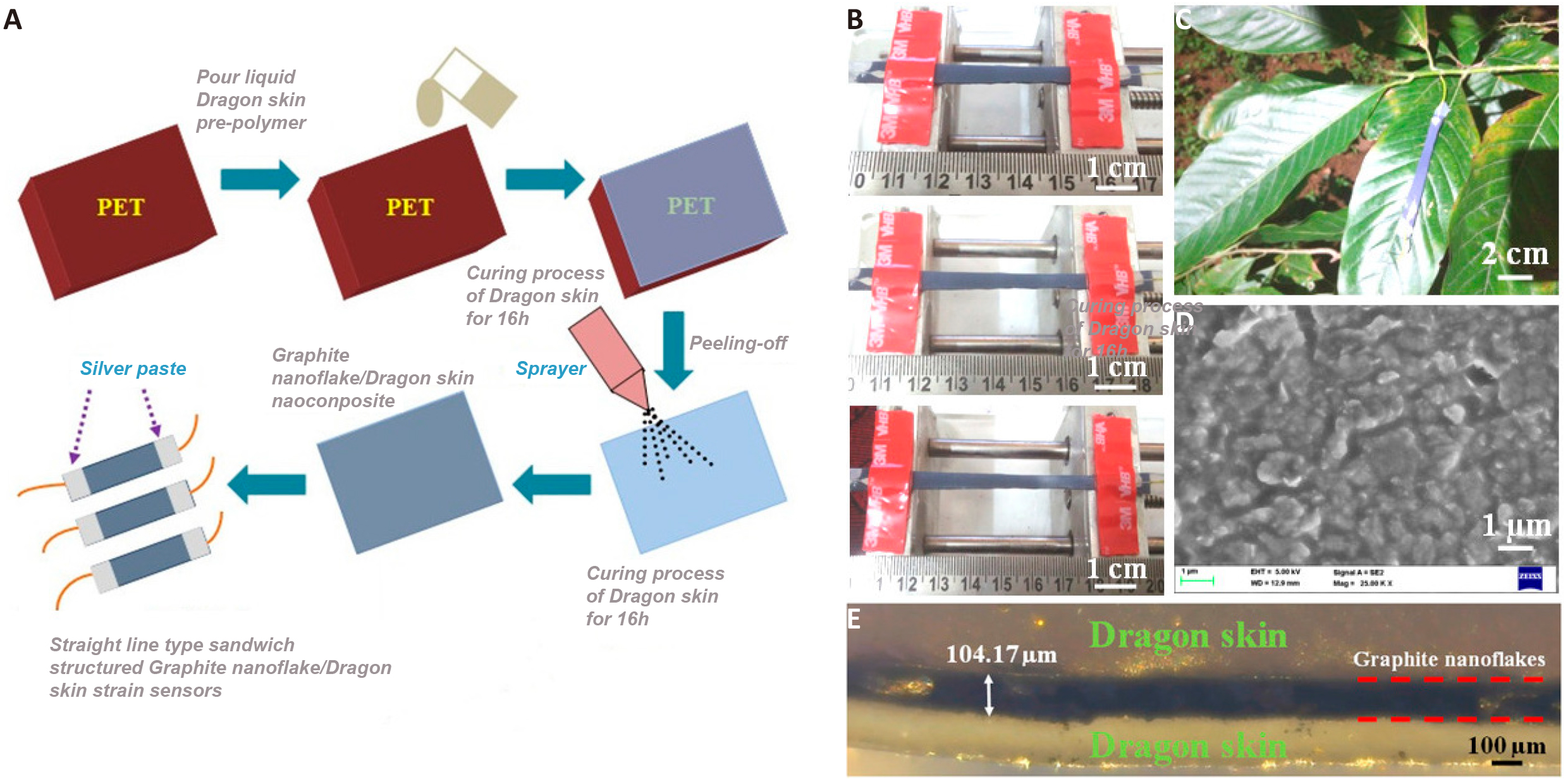
Figure 1. Preparation Process and Characterization of the Strain Sensors. A: Schematic diagram of the fabrication process for the Dragon skin/GNFs/Dragon skin sandwich structured nanocomposite strain sensor. B: Photos of the fabricated stretchable strain sensors under different scales of stretching are shown. C: Dragon skin/GNFs/Dragon skin sandwich structured nanocomposite strain sensor resting on a leaf demonstrating its light weight feature. D: SEM image of the obtained GNFs/Dragon skin nanocomposite (the scale bars represent 1μm). E: Cross-sectional optical image of the Dragon skin/GNFs/Dragon skin sandwich structured nanocomposite strain sensor demonstrating the strong adhesion and interfacial bonding of GNFs with Dragon skin matrix.
To examine the strain sensing performance of the Dragon skin/GNFs/Dragon skin composites, stretchable strain sensors were constructed through straight line-type sensor design utilizing soft and epidermal-like dragon skin stretchable supporting material.
In the relative change in resistance (RCR) versus strain data (Figure 2A), at the stretchability limit, the variation for straight line-type strain sensors ascended to 7.35 times the original relative resistance at a strain free condition. The evaluation of the strain sensitivity of these stretchable devices were carried out further by estimating their figure of merit, that is, the gauge factor, which is typically defined as 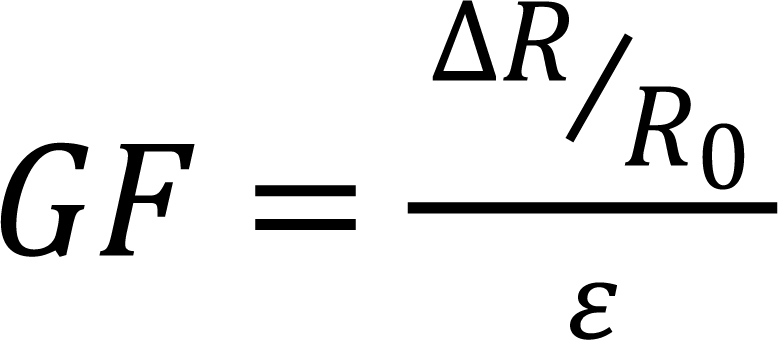 . Herein,
 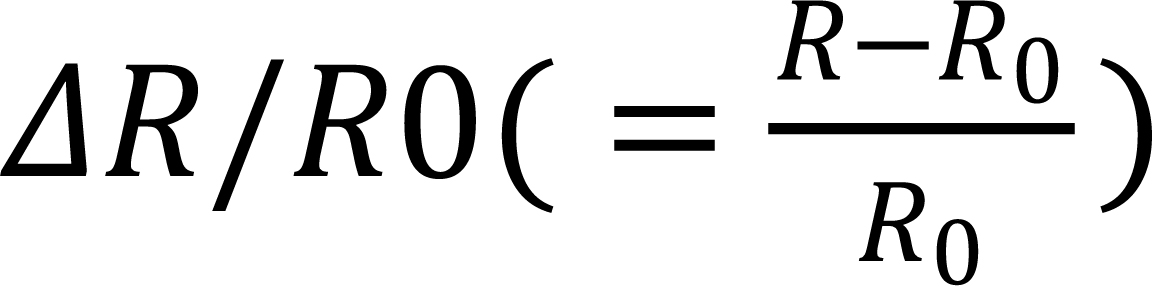 is the RCR and ε is the applied strain, where
 , (L0 and L represents the gauge length and length at a stretched condition, respectively)[8,13]. Owing to the above equation, the linear slope of the relative resistance variation versus strain plot could be utilized for the determination of the gauge factors of strain sensors. The wearable strain sensors based on GNFs conductive networks (with 7 spray pass) in straight line-type configurations exhibited large strain sensitivity with high gauge factors of 12.38 in 5-35% strain range, and 25.24 in 35-50% strain range, respectively. The straight line-type strain sensor exhibit a broad stretchability of 50% tensile strain range. When the mechanical deformation level exceeds this strain limit, the relative resistance variation promptly ascend to a large value (ΔR/R0>735.5%), indicating that the complete structural damage has occurred in the active sensor film. As illustrated in Figure 2B, the Dragon skin/GNFs/Dragon skin nanocomposite (with 2 spray pass) demonstrated ultra-large strain sensitivity with ultrasensitive gauge factors (GFs) of 1,542.25 in 0.3-1.6% strain range, and 41,326.15 in 1.6-2.3% strain range, respectively. As indicated in Figure 2C, this stretchable strain sensor exhibit a stable strain monitoring for a dynamic stimulation as low as ε=0.3%, which demonstrates that this device can be effectively utilized for the monitoring of small-scale human physiological and healthcare signals. The electromechanical characteristics of the GNFs conductive networks/Dragon skin nanocomposites are further explored. The stretchable strain sensors with different encapsulation layer thicknesses exhibit different working strain ranges and strain sensitivities. As presented in Figure 2D, the measured sensing strain ranges of sensors with 1.5mm, and 2mm encapsulation layer thickness are 2.3%, and 6%, respectively. The thicker stretchable supporting material prevents the mechanical decomposition and tensile failure, which can effectively absorb the mechanical deformations. Thus, the stretchable strain sensors with an encapsulation layer thickness of 2mm exhibit relatively larger sensing strain ranges than the sensors with an encapsulation layer thickness of 1.5mm. At this moment, since the mechanical deformations are absorbed by the stretchable supporting material, the internal disruption of the conductive sensing layer is relatively smaller. As a result, the stretchable strain sensors with an encapsulation layer thickness of 1.5mm delivers significantly larger GFs under the same tensile strain levels. The maximum GFs of the two types of GNFs conductive networks/Dragon skin nanocomposite strain sensors are 3,239.53, and 713.50, respectively. These performance merits are superior to the recently reported state-of-art stretchable strain sensors.
|
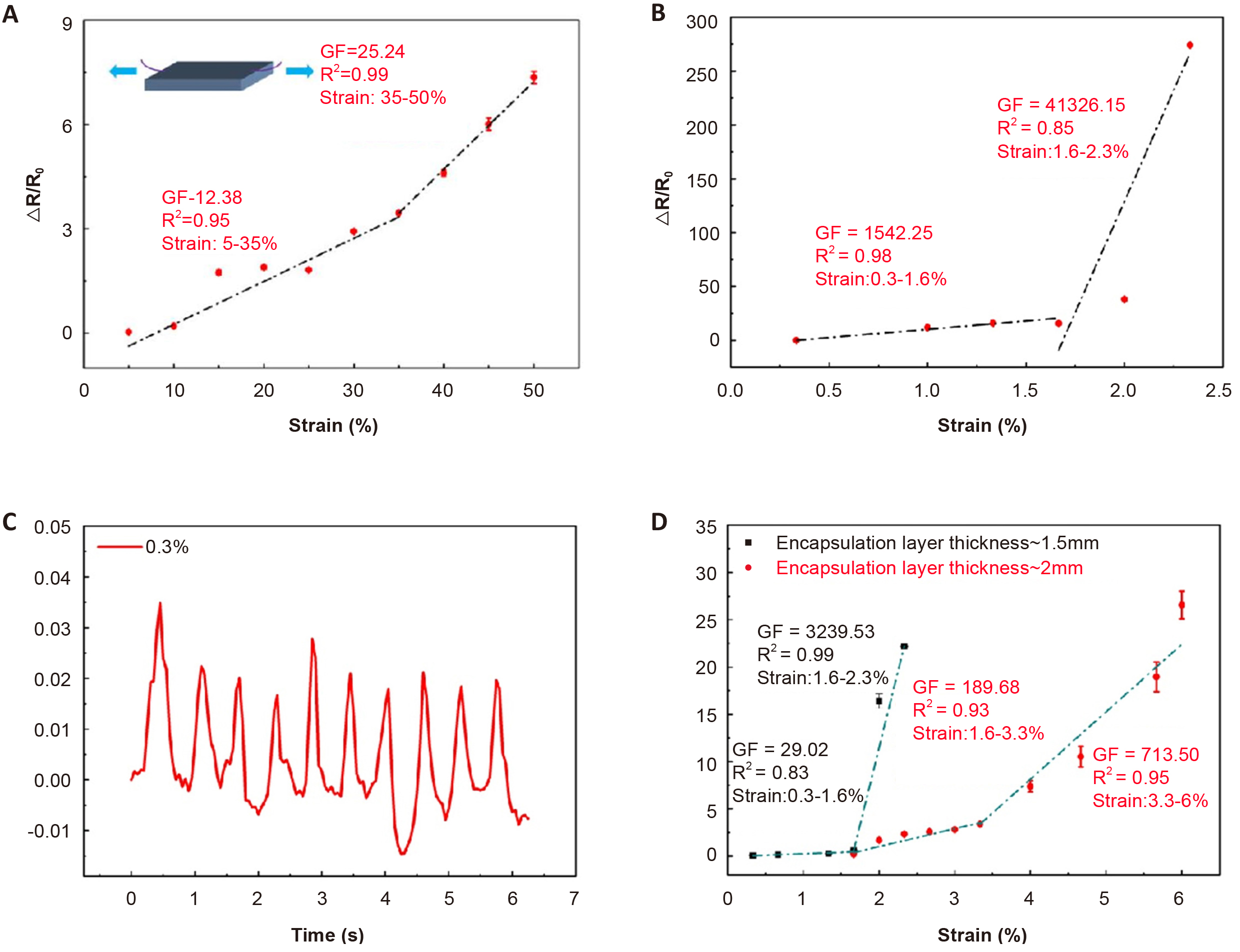
Figure 2. Electrical Responses of the Strain Sensors. A: RCR of the wearable strain sensor based on Dragon skin/GNFs/Dragon skin nanocomposites with 7 spray pass from 5 to 50% strain. Extracting the Gauge factors (GFs) through linear fitting the plot of (RCR versus applied strain. B: RCR of the wearable strain sensor based on Dragon skin/GNFs/Dragon skin nanocomposites with 2 spray pass from 0.3 to 2.3% strain. C: The RCR response of the strain sensor with 2 spray pass under a tiny strain of 0.3%. D: The RCR (at different encapsulation layer thickness) of the Dragon skin/GNFs/Dragon skin nanocomposites with 4 spray passes.
In recent years, there exists a dichotomy in constructing wearable and stretchable strain sensors with both large sensitivity and a broad strain range at the same moment. The values of gauge factor exhibit dependency on the type of active sensor materials and supporting materials/matrices employed. For instance, Wu et al.[71] developed GNPs/polyurethane nanocomposite based strain sensors with a gauge factor of 20. In another research, Zhang et al.[72] fabricated a sheath-core type graphite flakes/silk fibers composite strain sensors with a gauge factor of 14.5. However, these strain sensors exhibit low stretchability limits of 30%, and 15% strain, respectively. On the other hand, Kurian et al.[73] fabricated a polypyrrole/silicone rubber composite strain sensor with a high stretchability of 100%. However, these devices display limited strain sensitivity with a maximum gauge factor of only 1.7. In another research, Nankali et al.[6] constructed a highly stretchable CNT/polydimethylsiloxane (PDMS) nanocomposite based strain sensor with a stretchability of up to 60%. However, these stretchable strain sensors demonstrated a maximum gauge factor of only 10. In contrast, this work reports nanocomposite based strain sensors comprising of GNFs/Dragon skin sensor materials with high strain sensitivity and a wide sensing range at the same moment.
To investigate the wearable sensor strain responsivity, the micro-structural modifications were monitored through the analysis of the optical micrographs taken while stretching the GNFs/Dragon skin composites to over 60% strain (Figure 3). When a small-strain of 10% is applied onto the wearable sensor, the GNFs assembled onto the soft and epidermal-like dragon skin silicone elastomers can maintain the electrical conductance integrated owing to the highly efficient percolative conductive pathways. After that, when a large-strain of 30% is subjected onto the GNFs/Dragon skin composites, structural cracks begin to appear and upon further stretching, these cracks propagate owing to the mechanical mismatch between the brittle conductive films and the stretchable supporting materials, explaining the rapid variation of the electrical resistance signal of the wearable sensor to the applied strains.
Upon further subjecting these wearable sensors to a large-strain of 60%, the rapid separation of GNFs occur at the microcrack edges which dramatically reduces the electrically conductive pathways within the brittle GNFs, leading to a large electrical resistance variation of the wearable sensors under applied stretching strains demonstrating consistency with the high gauge factors and RCR of these devices as illustrated in Figure 2. On this occasion, the separation of GNFs exhibits a cut-off distance and the electron transport occurs through the quantum conductive junctions. The corresponding equivalent electrical networks are schematically depicted in Figure 3C.
In addition, it is worth to mention, the phenomena of crack generation and propagation has been utilized as an efficient mechanism to substantially enhance the strain sensitivity of epidermal-like stretchable and wearable strain sensors[74]. The GNFs are extended from the structural crack edges, these GNFs can effectively connect the crack islands and gaps, ensuring the prominent electronic transportation. As a result, the electrons can still be transported through neighbouring GNFs between the crack gaps even at a large-scale tensile strain, which guarantees a wide sensing range. Owing to the high sensitivity and a wide sensing range of the GNFs/Dragon skin composite strain sensors, these wearable devices can be of great applicability in healthcare and biomedical engineering, biomechanics and kinesiology applications, soft robotics and neuromechanics, and human machine interaction[8].
|
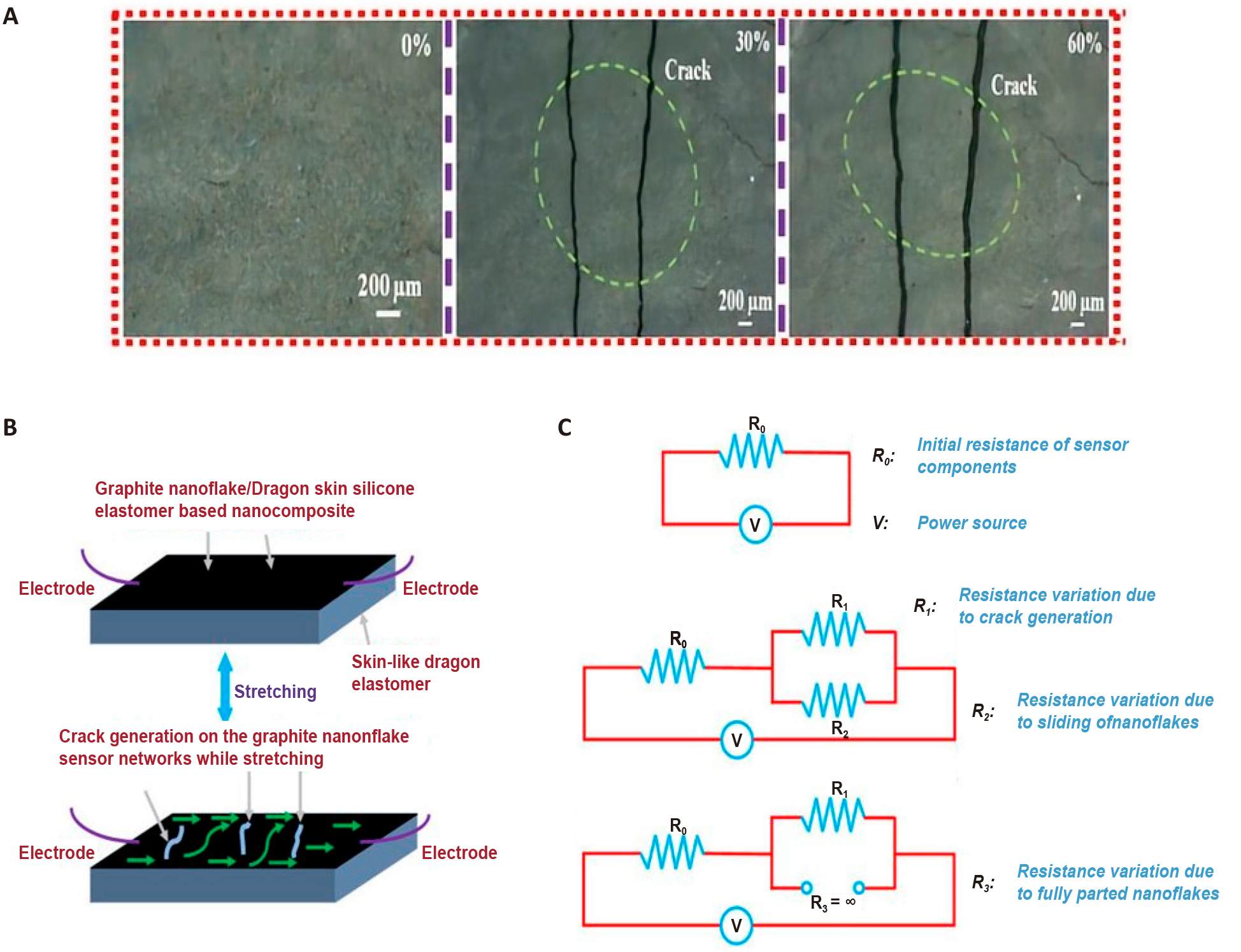
Figure 3. Working Mechanism of GNFs/Dragon Skin Nanocomposite Based Strain Sensor. A: Optical images illustrating the crack-morphology of the GNFs/Dragon skin nanocomposites at various stretching strains of 0%, 30%, and 60%. Scale bar: 200μm. B: Corresponding schematic depicting the generation and propagation of micro-scale cracks in the GNFs/Dragon skin nanocomposite upon stretching. C: Schematic depicting the electrical resistance networks of the Dragon skin/GNFs/Dragon skin sandwich structured nanocomposite strain sensor at an unstrained state, small-scale stretched state, and at a large-scale stretching, respectively.
For investigating the dynamic sensing characteristics of the wearable and stretchable strain sensors, the multi-scale external strains were systematically and uniformly subjected onto the devices (Figure 4A). During this moment, the sensor output signals in terms of electrical resistances were real-time monitored. The relative resistance variation of the straight line-type wearable devices ascends from 0 to 0.0386±0.00879, when the strain range increased from 0 to a small-scale strain of 5%. In addition, change in relative resistance increased further to 1.74±0.0719, and 1.89±0.0515, respectively, when the strain range reached a large-scale level of 15, and 20%, respectively, indicating the ability of these wearable sensors in monitoring multi-scale strains, which could be a benefit for full-range human health/motion monitoring applications. Meanwhile, it can be noticed that the RCR in general increased during the application of tensile force. This typical characteristic can be regarded as a positive strain effect[75,76]. In contrast, while reversing the tensile force, the RCR decreased and shoulder peaks were also noticed during the stretching-releasing cycles, this shoulder peak can be regarded as negative strain effect[75,76], which is an indication of the competition between destruction and reconstruction of conductive networks during dynamic cyclic strains[75-78]. Nonetheless, the relative resistance variation demonstrated prominent repeatability and stability in the multiple stretching-recovering cyclic strains.
The RCR of the Dragon skin/GNFs/Dragon skin nanocomposite strain sensors during the ten stretching/releasing cycles at 10% strain at different strain rates of 0.20, 0.25, 0.30, 0.40, 0.50, and 0.75mm/s, respectively, is shown in Figure 4B. It can be clearly observed that the strain sensors demonstrate negligible dependency with respect to cyclic stretching-releasing in the tested strain rate range of 0.20-0.75mm/s and exhibits prominent recovery performance when the applied strain is reversed indicating the high performance of the Dragon skin/GNFs/Dragon skin sandwich structured nanocomposite strain sensors. The baseline drift in the RCR signal at higher strain rates can be attributed to the migration as well as reorientation of the GNFs in the Dragon skin matrix resulting in the alteration of original continuous conductive pathways. Moreover, it can be noticed that the RCR signal cannot fully reverse to its initial value in first releasing process for each applied tensile strain rate, which emanates from the hysteresis effect occurring due to the viscoelastic stretchable supporting material and perpetual destruction of the electrically conductive networks.
|
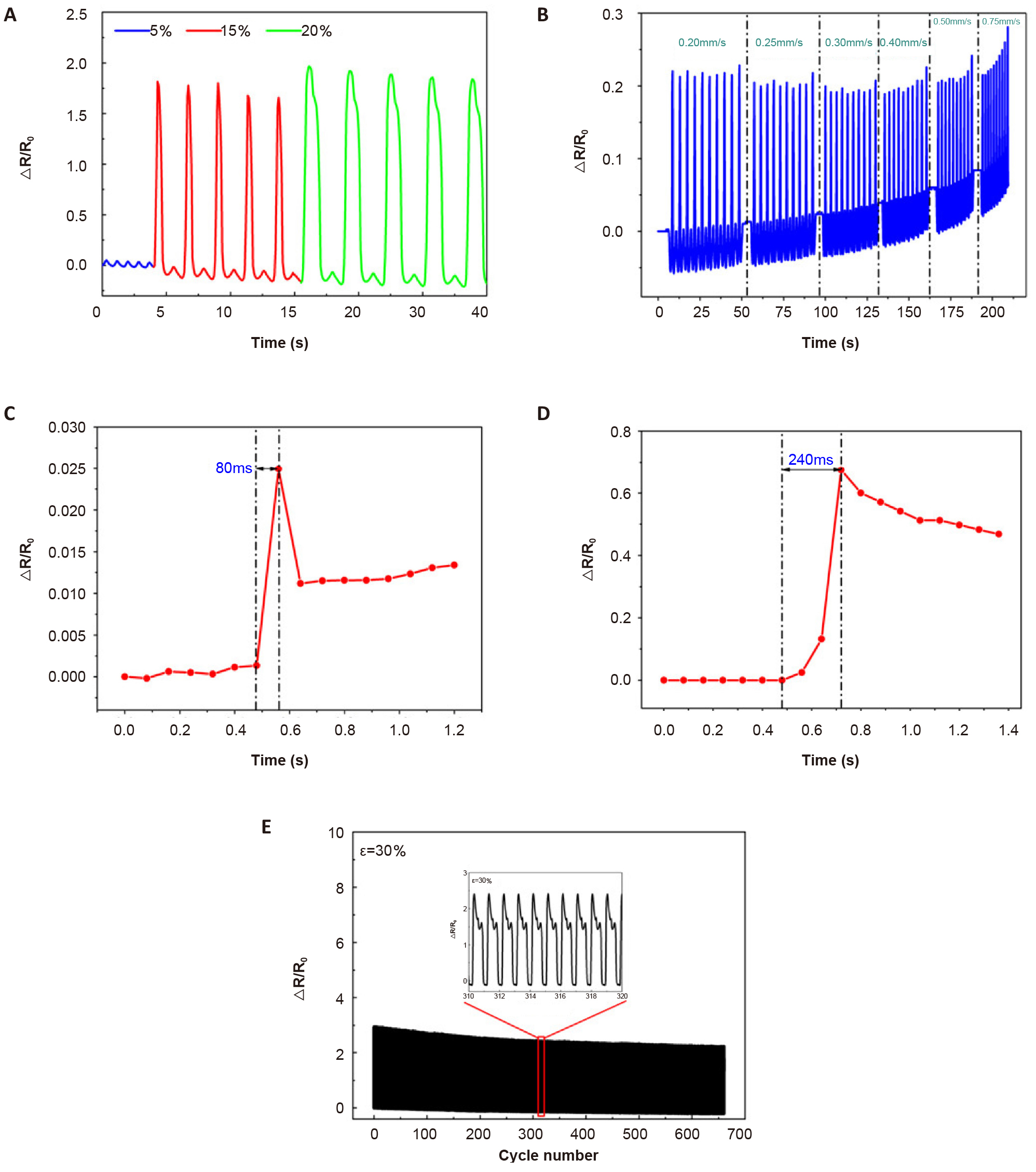
Figure 4. The RCR of the Dragon Skin/GNFs/Dragon Skin Sandwich Structured Nanocomposite Strain Sensor under Various Cyclic Tensile Loadings. A: Relative change in resistance (RCR) under different stretching strains. B: RCR for different stretching strain rates (0.20, 0.25, 0.30, 0.40, 0.50, and 0.75mm/s) under a tensile strain of 10%. C: The response time of the strain sensor under 5% strain. D: The response time of the strain sensor under a large-scale 30% strain. E: Stability and durability investigation at a frequency of 1Hz under a large-scale tensile strain of 30% for more than 600 cycles.
In order to evaluate the response time of the as-fabricated wearable strain sensors, instant stretching (strain rate of 600mm·min-1) was carried out under both small-scale and large-scale strains of 5 and 30%, respectively as illustrated in Figure 4C and 4D. For wearable strain sensors, the response time is a crucial parameter for the practical application of the Dragon skin/GNFs/Dragon skin sandwich structured nanocomposite strain sensors. The straight line-type sensors demonstrate a super-fast strain responsiveness with response time as low as 80ms, and 240ms, respectively under 5%, and 30% strain. The above mentioned results demonstrate attractive perspectives in the detection of complicated human motions.
Furthermore, the durability of the wearable strain sensors was evaluated by subjecting them under large-scale 30% strain for more than 600 stretch-release cycles as illustrated in Figure 4E. It is observed that the maximum value of RCR signal slightly declines in the initial several stretching-releasing cycles, which results from the formation of supplemental conductive pathways and the rearrangement of conductive networks during the dynamic cyclic strains. At a later stage, the electrical signal remains consistent in the following cycles. Meanwhile, the minimum value of RCR signal also can be unvaried after several stretching-releasing cycles, implying stable repeatability and durability of the stretchable strain sensors. Minute performance degradation in the relative resistance variation signal was observed under these long-term stretch-release cycles, indicating prominent mechanical resilience of the wearable devices.
The Dragon skin/GNFs/Dragon skin nanocomposite was employed for wearable sensing applications to monitor full-range human motions by laminating the device onto various epidermal spots of the human body with the aid of Skin-Tite, a bio-adhesive. Initially, the wearable strain sensor presented here can also monitor slight human physiological activity including blinking of an eye, cheek motion as well as frowning, indicating the emotional state of humans (Figure 5A, B, and D)[79]. Human emotion detection is critical in the field of human monitoring[80]. During the cyclic muscle tissue movements, the electrical resistance of this wearable strain sensor varied with favourable reproducibility. After that, when the wearable device was mounted onto the human throat, the laryngeal prominence movements and the vibration of vocal cords could be monitored and spoken letters, such as “Graphite”, and “Nanoflakes”, were effectively distinguished through the shape of the RCR (Figure 5C). One can clearly identify distinctive electrical response pattern for each of the words, implying the ability of the stretchable strain sensor to monitor phonation. Pronouncing the word “Nanoflakes” produced a fast and sensitive response with a larger frequency compared to that of the word “Graphite”. Hence, the Dragon skin/GNFs/Dragon skin nanocomposite could be utilized in speech monitoring and other human larynx movement-related applications. Moreover, the open-close postures of fingers were also monitored by laminating the device in the middle of two fingers (Figure 6E). The strain sensor demonstrated a relative resistance variation in a step-wise manner while holding the device at different bending angles, indicating its promising potential in gesture recognition. These wearable sensing applications demonstrate the significant potential of the Dragon skin/GNFs/Dragon skin nanocomposite based wearable devices in the field of healthcare and biomedical engineering, gesture-controlled robotics, athletic performance monitoring, and virtual reality as well as entertainment technologies[4,8] .
Apart from monitoring small-strain mechanical deformations, the wearable strain sensor also exhibits a reliable responsiveness to large-strain human motions including bending process of a finger, wrist, elbow, and knee joint deformations (Figure 6A-D, and F). Different degrees of finger joint bending were identified reliably using the Dragon skin/GNFs/Dragon skin nanocomposite based strain sensor, indicating its substantial potential in human posture monitoring. The motions induced by the bending of human wrist, arms, and human legs (during walking, running, and squatting) were monitored in real-time continuously, indicating the promising potential of the Dragon skin/GNFs/Dragon skin nanocomposite based strain sensor in the monitoring of sports activities, human motion monitoring, and human-machine interfaces[8].
|
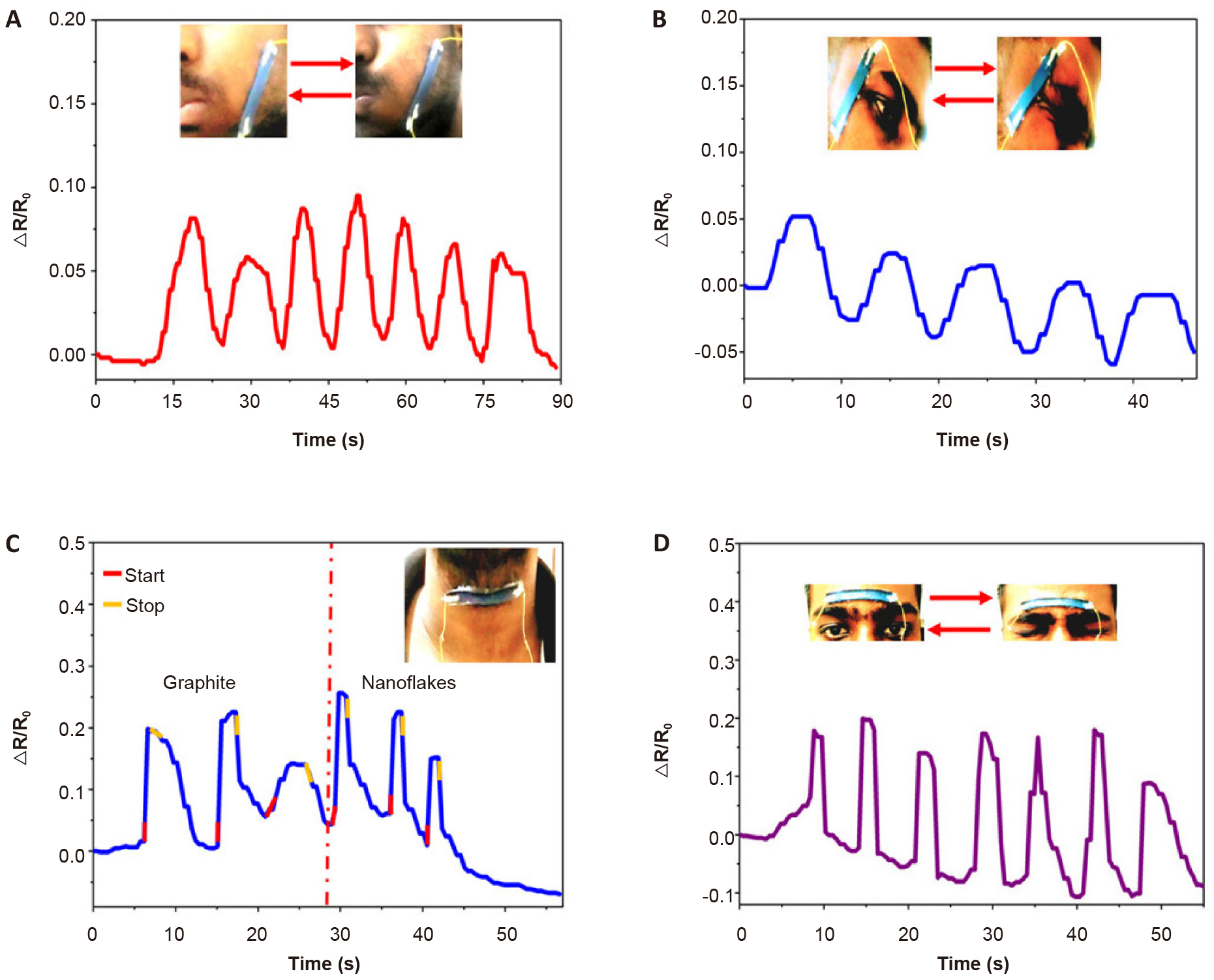
Figure 5. Small-scale Sensing by the Dragon Skin/GNFs/Dragon Skin Sandwich Structured Nanocomposite Strain Sensor. The RCR of the strain sensor to (A) cheek movement, (B) eye blinking, (C) vocal cords vibration while phonating different words, "Graphite", and "Nanoflakes", respectively, and (D) frowning. Insets: photos of a Dragon skin/GNFs/Dragon skin sandwich structured nanocomposite strain sensor mounted onto a human cheek, canthus, larynx, and forehead with corresponding motions.
|
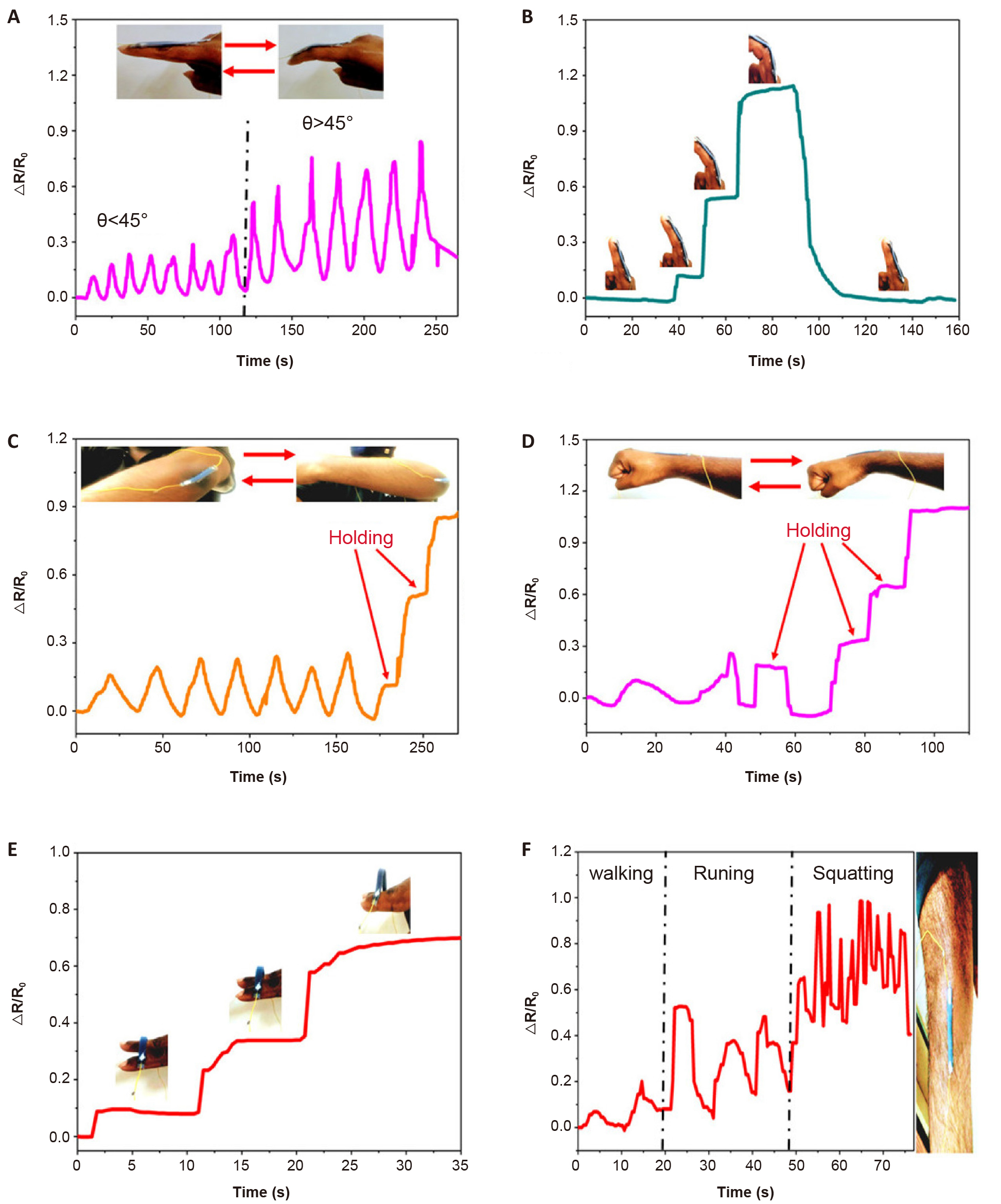
Figure 6. Large-scale Sensing by the Dragon Skin/GNFs/Dragon Skin Sandwich Structured Nanocomposite Strain Sensor. The RCR of the strain sensor to (A) bending process of a finger under different modes, (B) step-wise finger bending, (C) elbow bending and holding, (D) wrist bending and holding, (E) closing process of the fingers, and (F) walking, running, and squatting activity of a knee joint. Insets: photos of a Dragon skin/GNFs/Dragon skin sandwich structured nanocomposite strain sensor mounted onto the finger knuckles, elbow, wrist, between the fingers, and knee joint with respective movements.
Finally, the strain monitoring performance for previously reported strain sensors have been compared with the Dragon skin/GNFs/Dragon skin nanocomposite strain sensor in Table 1. It can be noticed that the stretchable strain sensors reported in this work demonstrates high performance, indicating substantial potential for utilization in future wearable electronic devices and soft machines.
Table 1. Performance Comparison of the GFs with Respect to the Maximum Strain Sensing Range for Previously Reported Flexible/stretchable Strain Sensors
Sensor Type |
Fabrication process |
Materials |
GF |
Strain Range |
Ref. |
Resistive |
Chemical vapor deposition |
CNT embroidered graphene |
0.36 |
20% |
Shi et al.[53] |
Resistive |
Dry-Meyer-rod coating |
Graphite flakes/silk fibers-Ecoflex |
14.5 |
15% |
Zhang et al.[59] |
Resistive |
Drop casting |
CNT/PDMS |
15 |
25% |
Li et al.[81] |
Capacitive |
Capillary force lithography |
AgNWs/PDMS |
2 |
30% |
Kim et al.[82] |
Resistive |
Roll-to-roll gravure printing |
Ag flake/PI |
2.24 |
1.6% |
Park et al.[83] |
Resistive |
Dip coating, and roll-to-roll process |
GNPs/Polyurethane |
20 |
30% |
Wu et al.[71] |
Optical |
Drop casting |
Polystyrene-AuNCs/PDMS |
0.47 |
40% |
Fu et al.[84] |
Resistive |
Drop casting |
AgNWs/PDMS |
8.32 |
20% |
Hashemi et al.[85] |
Resistive |
Spin coating, lithography, and laser cutting |
Constantan/PI-Ecoflex |
< 1 |
50% |
Li et al.[86] |
Resistive |
Sputtering |
Platinum/Polyurethane acrylate |
2,000 |
2% |
Kang et al.[87] |
Resistive |
Spray coating |
GNFs/Dragon skin |
41,326.15 |
50% |
This work |
4 CONCLUSION
In summary, this investigation presented the development of high performance stretchable strain sensors composed of GNFs networks sandwiched in between two slabs of epidermis-like Dragon skin elastomers via a low-cost, and scalable spray coating technique. The Dragon skin/GNFs/Dragon skin sandwich structured nanocomposite strain sensors demonstrated several fascinating merits including ultra-high sensitivity (a gauge factor of 41326.15 in the strain range of 1.6-2.3%), a sensing range of up to 50% strain, prominent linearity, quick response time (80ms), and excellent dynamic durability and cyclability (more than 600 stretching-releasing cycles under a large-scale dynamic tensile strain of 30%). The excellent dynamic durability and cyclability can be attributed to the highly elastic nature as well as the strong interfacial adhesion between GNFs networks and Dragon skin elastomeric matrix owing to the sandwich structure. Moreover, owing to the simple device designs and structures, easy readout mechanisms, and strong piezoresistivity, the Dragon skin/GNFs/Dragon skin sandwich structured nanocomposite strain sensors can be employed as a wearable monitor for practical applications with favourable reproducibility and stability.
Acknowledgments
Not applicable.
Conflicts of Interest
There are no conflicts of interest.
Data Availability
All data generated or analyzed during this study are included in this published article.
Copyright Permissions
Copyright © 2025 The Author(s). Published by Innovation Forever Publishing Group Limited. This open-access article is licensed under a Creative Commons Attribution 4.0 International License (https://creativecommons.org/licenses/by/4.0), which permits unrestricted use, sharing, adaptation, distribution, and reproduction in any medium, provided the original work is properly cited.
Author Contribution
Madhavan R did the independent research and full-contribution.
Abbreviation List
CNTs, Carbon nanotubes
GF, Gauge factor
GNFs, Graphite nanoflakes
GNPs, Graphite nanoplatelets
PDMS, Polydimethylsiloxane
PET, Polyethylene terephthalate
PI, Polyimide
RCR, Relative change in resistance
SEM, Scanning electron microscopy
References
[1] Madhavan R. Network crack-based high performance stretchable strain sensors for human activity and healthcare monitoring. New J Chem, 2022; 46: 17596-17609.[DOI]
[2] Madhavan R. Nanocrack-based ultrasensitive wearable and skin-mountable strain sensors for human motion detection. Mater Adv, 2022; 3: 8665-8676.[DOI]
[3] Madhavan R. Epidermis-like high performance wearable strain sensor for full-range monitoring of the human activities. Macromol Mater Eng, 2022; 307: 2200034.[DOI]
[4] Madhavan R. High performance conductive composites and e-skins with large-scale manufacturing for wearable electronic sensor systems. J Mod Nanotechnol, 2024; 4: 5.[DOI]
[5] Cheng SB, Narang YS, Yang CH et al. Stick-on large-strain sensors for soft robots. Adv Mater Interfaces, 2019; 6: 1900985.[DOI]
[6] Nankali M, Nouri NM, Navidbakhsh M et al. Highly stretchable and sensitive strain sensors based on carbon nanotube–elastomer nanocomposites: the effect of environmental factors on strain sensing performance. J Mater Chem C, 2020; 8: 6185-6195.[DOI]
[7] Amjadi M, Pichitpajongkit A, Lee S et al. Highly Stretchable and Sensitive Strain Sensor Based on Silver Nanowire–Elastomer Nanocomposite. ACS Nano, 2014; 8: 5154-5163.[DOI]
[8] Souri H, Banerjee H, Jusufi A et al. Wearable and Stretchable Strain Sensors: Materials, Sensing Mechanisms, and Applications. Adv Intell Syst, 2020; 2: 2000039.[DOI]
[9] Amjadi M, Kyung KU, Park I et al. Stretchable, Skin-Mountable, and Wearable Strain Sensors and Their Potential Applications: A Review. Adv Funct Mater, 2016; 26: 1678-1698.[DOI]
[10] Xie Y, Xie R, Yang HC et al. Iono-Elastomer-Based Wearable Strain Sensor with Real-Time Thermomechanical Dual Response. ACS Appl Mater Inter, 2018; 10: 32435-32443.[DOI]
[11] Liao X, Song W, Zhang X et al. Directly printed wearable electronic sensing textiles towards human–machine interfaces. J Mater Chem C, 2018; 6: 12841-12848.[DOI]
[12] Wang K, Yap LW, Gong S et al. Nanowire-Based Soft Wearable Human–Machine Interfaces for Future Virtual and Augmented Reality Applications. Adv Funct Mater, 2021; 31: 2008347.[DOI]
[13] Heikenfeld J, Jajack A, Rogers J et al. Wearable sensors: modalities, challenges, and prospects. Lab Chip, 2018; 18: 217-248.[DOI]
[14] Sempionatto JR, Jeerapan I, Krishnan S et al. wearable chemical sensors: emerging systems for on-body analytical chemistry. Anal Chem, 2020; 92: 378-396.[DOI]
[15] Liu J, Guo Q, Mao S et al. Templated synthesis of a 1D Ag nanohybrid in the solid state and its organized network for strain-sensing applications. J Mater Chem C, 2018; 6: 10730– 10738.[DOI]
[16] Sun Z, Yang S, Zhao P et al. Skin-like ultrasensitive strain sensor for full-range detection of human health monitoring. Acs Appl Mater Inter, 2020; 12: 13287-13295.[DOI]
[17] Xu K, Lu Y, Honda S et al. Highly stable kirigami-structured stretchable strain sensors for perdurable wearable electronics. J Mater Chem C, 2019; 7: 9609-9617.[DOI]
[18] Cai G, Yang M, Xu Z et al. Flexible and wearable strain sensing fabrics. Chem Eng J, 2017; 325: 396-403.[DOI]
[19] Fang X, Tan J, Gao Y et al. High-performance wearable strain sensors based on fragmented carbonized melamine sponges for human motion detection. Nanoscale, 2017; 9: 17948-17956.[DOI]
[20] Gao Y, Li Q, Wu R et al. Laser direct writing of ultrahigh sensitive sic-based strain sensor arrays on elastomer toward electronic skins. Adv Funct Mater, 2018; 29: 1806786.[DOI]
[21] Xu M, Qi J, Li F et al. Highly stretchable strain sensors with reduced graphene oxide sensing liquids for wearable electronics. Nanoscale, 2018; 10: 5264-5271.[DOI]
[22] Xu H, Lv Y, Qiu D et al. An ultra-stretchable, highly sensitive and biocompatible capacitive strain sensor from an ionic nanocomposite for on-skin monitoring. Nanoscale, 2019; 11: 1570-1578.[DOI]
[23] Wang H, Li D, Zhong W et al. Self-powered inhomogeneous strain sensor enabled joint motion and three-dimensional muscle sensing. Acs Appl Mater Inter, 2019; 11: 34251-34257.[DOI]
[24] Wang P, Li G, Liu J et al. Flexible, freestanding, ultrasensitive, and iontronic tactile sensing textile. Acs Appl Electron Ma, 2021; 3: 2195-2202.[DOI]
[25] Sherburne MD, Roberts CR, Brewer JS et al. Comprehensive optical strain sensing through the use of colloidal quantum dots. Acs Appl Mater Inter, 2020; 12: 44156-44162.[DOI]
[26] Liao XQ, Zhang Z, Kang Z et al. Ultrasensitive and stretchable resistive strain sensors designed for wearable electronics. Mater Horiz, 2017; 4: 502-510.[DOI]
[27] Tian B, Yao W, Zeng P et al. All-printed, low-cost, tunable sensing range strain sensors based on Ag nanodendrite conductive inks for wearable electronics. J Mater Chem C, 2019; 7: 809-818.[DOI]
[28] Zhu L, Zhou X, Liu Y et al. Highly sensitive, ultrastretchable strain sensors prepared by pumping hybrid fillers of carbon nanotubes/cellulose nanocrystal into electrospun polyurethane membranes. Acs Appl Mater Inter, 2019; 11: 12968-12977.[DOI]
[29] Xin Y, Zhou J, Xu X et al. Laser-engraved carbon nanotube paper for instilling high sensitivity, high stretchability, and high linearity in strain sensors. Nanoscale, 2017; 9: 10897-10905.[DOI]
[30] Li Z, Zhang B, Li K et al. A wide linearity range and high sensitivity flexible pressure sensor with hierarchical microstructures via laser marking. J Mater Chem C, 2020; 8: 3088-3096.[DOI]
[31] Kim K, Hong SK, Ha SH et al. Enhancement of linearity range of stretchable ultrasensitive metal crack strain sensor via superaligned carbon nanotube-based strain engineering. Mater Horiz, 2020; 7: 2662-2672.[DOI]
[32] Wang Z, Chen J, Cong Y et al. Ultrastretchable strain sensors and arrays with high sensitivity and linearity based on super tough conductive hydrogels. Chem Mater, 2018; 30: 8062-8069.[DOI]
[33] Zhao S, Meng X, Liu L et al. Polypyrrole-coated copper nanowire-threaded silver nanoflowers for wearable strain sensors with high sensing performance. Chem Eng J, 2021; 417: 127966.[DOI]
[34] Han S, Liu C, Xu H et al. Multiscale nanowire-microfluidic hybrid strain sensors with high sensitivity and stretchability. NPJ Flex Electron, 2018; 2: 16.[DOI]
[35] Zheng M, Li W, Xu M et al. Strain sensors based on chromium nanoparticle arrays. Nanoscale, 2014; 6: 3930-3933.[DOI]
[36] Seyedin S, Zhang P, Naebe M et al. Textile strain sensors: a review of the fabrication technologies, performance evaluation and applications. Mater Horiz, 2019; 6: 219-249.[DOI]
[37] Yan C, Wang J, Kang W et al. Highly stretchable piezoresistive graphene–nanocellulose nanopaper for strain sensors. Adv Mater, 2014; 26: 2022-2027.[DOI]
[38] Rahimi R, Ochoa M, Yu W et al. Highly stretchable and sensitive unidirectional strain sensor via laser carbonization. Acs Appl Mater Inter, 2015; 7: 4463-4470.[DOI]
[39] Sun S, Liu Y, Chang X et al. A wearable, waterproof, and highly sensitive strain sensor based on three-dimensional graphene/carbon black/Ni sponge for wirelessly monitoring human motions. J Mater Chem C, 2020; 8: 2074-2085.[DOI]
[40] Kim K, Lee J, Jo E et al. Patterned Carbon Nanotube Bundles as Stretchable Strain Sensors for Human Motion Detection. ACS Applied Nano Mat, 2020; 3: 11408-11415.[DOI]
[41] Zou Q, He K, Ou-Yang J et al. Highly Sensitive and Durable Sea-Urchin-Shaped Silver Nanoparticles Strain Sensors for Human-Activity Monitoring. ACS Appl Mater Inter, 2021; 13: 14479-14488.[DOI]
[42] Feng P, Yuan Y, Zhong M et al. Integrated Resistive-Capacitive Strain Sensors Based on Polymer-Nanoparticle Composites. ACS Appl Nano Mater, 2020; 3: 4357-4366.[DOI]
[43] Pan S, Liu Z, Wang M et al. Mechanocombinatorially screening sensitivity of stretchable strain sensors. Adv Mater, 2019; 31: 1903130.[DOI]
[44] Pan L, Liu G, Shi W et al. Mechano-regulated metal–organic framework nanofilm for ultrasensitive and anti-jamming strain sensing. Nat Commun, 2018; 9: 3813.[DOI]
[45] Liu X, Liang X, Lin Z et al. Highly Sensitive and Stretchable Strain Sensor Based on a Synergistic Hybrid Conductive Network. ACS Appl Mater Inter, 2020; 12: 42420-42429.[DOI]
[46] He Y, Wu D, Zhou M et al. Wearable Strain Sensors Based on a Porous Polydimethylsiloxane Hybrid with Carbon Nanotubes and Graphene. ACS Appl Mater Inte, 2021; 13: 15572-15583.[DOI]
[47] Xu J, Jin R, Ren X et al. Cartilage-inspired hydrogel strain sensors with ultrahigh toughness, good self-recovery and stable anti-swelling properties. J Mater Chem A, 2019; 7: 25441-25448.[DOI]
[48] Fu H, Wang B, Li J et al. Ultra-strong, nonfreezing, and flexible strain sensors enabled by biomass-based hydrogels through triple dynamic bond design. Mater Horiz, 2024; 11: 1588-1596.[DOI]
[49] Yang Y, Shi L, Cao Z et al. Strain sensors with a high sensitivity and a wide sensing range based on a Ti3C2Tx (MXene) nanoparticle–nanosheet hybrid network. Adv Funct Mater, 2019; 29: 1807882.[DOI]
[50] Yang H, Xiao X, Li Z et al. Wireless Ti3C2Tx MXene strain sensor with ultrahigh sensitivity and designated working windows for soft exoskeletons. ACS Nano, 2020; 14: 11860-11875.[DOI]
[51] Seyedin S, Uzun S, Levitt A et al. MXene composite and coaxial fibers with high stretchability and conductivity for wearable strain sensing textiles. Adv Funct Mater, 2020; 30: 1910504.[DOI]
[52] Yang Z, Pang Y, Han X et al. Graphene Textile Strain Sensor with Negative Resistance Variation for Human Motion Detection. ACS Nano, 2018; 12: 9134-9141.[DOI]
[53] Shi J, Li X, Cheng H et al. Graphene Reinforced Carbon Nanotube Networks for Wearable Strain Sensors. Adv Funct Mater, 2016; 26: 2078-2084.[DOI]
[54] Liu W, Huang Y, Peng Y et al. Stable Wearable strain Sensors on Textiles by Direct Laser Writing of Graphene. ACS Appl Nano Mater, 2020; 3: 283-293.[DOI]
[55] Tian H, Shu Y, Cui YL et al. Scalable fabrication of high-performance and flexible graphene strain sensors. Nanoscale, 2014; 6: 699-705.[DOI]
[56] Dias A, Chagas C, Silva-Neto H et al. Environmentally Friendly Manufacturing of Flexible Graphite Electrodes for a Wearable Device Monitoring Zinc in Sweat. ACS Appl Mater Inter, 2019; 11: 39484-39492.[DOI]
[57] Wu J, Wang H, Su Z et al. Highly Flexible and Sensitive Wearable E-Skin Based on Graphite Nanoplatelet and Polyurethane Nanocomposite Films in Mass Industry Production Available. ACS Appl Mater Inter, 2017; 9: 38745-38754.[DOI]
[58] Chen F, Gu Y, Cao S et al. Low-cost highly sensitive strain sensors for wearable electronics. J Mater Chem C, 2017; 5: 10571-10577.[DOI]
[59] Zhang M, Wang C, Wang Q et al. Sheath-Core Graphite/Silk Fiber Made by Dry-Meyer-Rod-Coating for Wearable Strain Sensors. ACS Appl Mater Inter, 2016; 8: 20894-20899.[DOI]
[60] Shen Z, and Feng J. Mass-produced SEBS/graphite nanoplatelet composites with a segregated structure for highly stretchable and recyclable strain sensors. J Mater Chem C, 2019; 7: 9423-9429.[DOI]
[61] Gao M, Li L, Song Y et al. Inkjet printing wearable electronic devices. J Mater Chem C, 2017; 5: 2971-2993.[DOI]
[62] Carey T, Jones C, Moal FL et al. Spray-Coating Thin Films on Three-Dimensional Surfaces for a Semitransparent Capacitive-Touch Device. ACS Appl Mater Inter, 2018; 10: 19948-19956.[DOI]
[63] Song YX, Xu WM, Rong MZ et al. A sunlight self-healable transparent strain sensor with high sensitivity and durability based on a silver nanowire/polyurethane composite film. J Mater Chem A, 2019; 7: 2315-2325.[DOI]
[64] Li Y, Wang S, Xiao ZC et al. Flexible TPU strain sensors with tunable sensitivity and stretchability by coupling AgNWs with rGO. J Mater Chem C, 2020; 8: 4040-4048.[DOI]
[65] Feng X, He Y, Qu W et al. Spray-coated perovskite hemispherical photodetector featuring narrow-band and wide-angle imaging. Nat Commun, 2022; 13: 6106.[DOI]
[66] Biele M, Benavides CM, Hürdler J et al. Spray-coated organic photodetectors and image sensors with silicon-like performance. Adv Mater Technol, 2019; 4: 1800158.[DOI]
[67] Liu C, Li J, Che L et al. Toward large-scale fabrication of triboelectric nanogenerator (TENG) with silk-fibroin patches film via spray-coating process. Nano Energy, 2017; 41: 359-366.[DOI]
[68] Yu X, Zhou N, Han S et al. Flexible spray-coated TIPS-pentacene organic thin-film transistors as ammonia gas sensors. J Mater Chem C, 2013; 1: 6532-6535.[DOI]
[69] Say MG, Brooke R, Edberg J et al. Spray-coated paper supercapacitors. npj Flex Electron, 2020; 4: 14.[DOI]
[70] Cheng Y, Wang R, Zhai H et al. Stretchable electronic skin based on silver nanowire composite fiber electrodes for sensing pressure, proximity, and multidirectional strain. Nanoscale, 2017; 9: 3834-3842.[DOI]
[71] Wu J, Ma Z, Hao Z et al. Sheath–Core Fiber Strain Sensors Driven by in-situ Crack and Elastic Effects in Graphite Nanoplate Composites. ACS Appl Nano Mater, 2019; 2: 750-759.[DOI]
[72] Zhang M, Wang C, Wang Q et al. Sheath–Core Graphite/Silk Fiber Made by Dry-Meyer-Rod-Coating for Wearable Strain Sensors. ACS Appl Mater Inter, 2016; 8: 20894-20899.[DOI]
[73] Kurian AS, Souri H, Mohan VB et al. Highly stretchable strain sensors based on polypyrrole-silicone rubber composites for human motion detection. Sens Actuators A, 2020; 312: 112131.[DOI]
[74] Wang H, Zhou R, Li D et al. High-Performance Foam-Shaped Strain Sensor Based on Carbon Nanotubes and Ti3C2Tx MXene for the Monitoring of Human Activities. ACS Nano, 2021; 15: 9690-9700.[DOI]
[75] Gong H, Cai C, Gu H et al. Flexible and wearable strain sensor based on electrospun carbon sponge/polydimethylsiloxane composite for human motion detection. RSC Adv, 2021; 11: 4186-4193.[DOI]
[76] Salaeh S, Das A, Stöckelhuber KW et al. Fabrication of a strain sensor from a thermoplastic vulcanizate with an embedded interconnected conducting filler network. Composites Part A, 2020; 130: 105763.[DOI]
[77] Sang Z, Ke K, Manas-Zloczower I et al. Effect of carbon nanotube morphology on properties in thermoplastic elastomer composites for strain sensors. Compos Part A-Appl S, 2019; 121: 207-212.[DOI]
[78] Xiang D, Zhang X, Li Y et al. Enhanced performance of 3D printed highly elastic strain sensors of carbon nanotube/thermoplastic polyurethane nanocomposites via non-covalent interactions. Compos Part B-Eng, 2019; 176: 107250.[DOI]
[79] Roh E, Hwang B, Kim D et al. Stretchable, Transparent, Ultrasensitive, and Patchable Strain Sensor for Human–Machine Interfaces Comprising a Nanohybrid of Carbon Nanotubes and Conductive Elastomers. ACS Nano, 2015; 9: 6252-6261.[DOI]
[80] Wang C, Xia K, Jian M et al. Carbonized silk georgette as an ultrasensitive wearable strain sensor for full-range human activity monitoring. J Mater Chem C, 2017; 5: 7604-7611.[DOI]
[81] Li Q, Li J, Tran D et al. Engineering of carbon nanotube/polydimethylsiloxane nanocomposites with enhanced sensitivity for wearable motion sensors. J Mater Chem C, 2017; 5: 11092-11099.[DOI]
[82] Kim SR, Kim JH, Park JW. Wearable and Transparent Capacitive Strain Sensor with High Sensitivity Based on Patterned Ag Nanowire Networks. ACS Appl Mater Inter, 2017; 9: 26407-26416.[DOI]
[83] Park J, Nam D, Park S et al. Fabrication of flexible strain sensors via roll-to-roll gravure printing of silver ink. Smart Mater Struct, 2018; 27: 085014.[DOI]
[84] Fu R, Warnakula T, Shi Q et al. Plasmene nanosheets as optical skin strain sensors. Nanoscale Horiz, 2020; 5: 1515-1523.[DOI]
[85] Hashemi P, Mehranpour M, Ghasemi I. Fabrication of a strain sensor based on polymer/silver nanowires nanocomposite for medical applications: Siloxane based versus urethane based nanocomposites. Polym Compos, 2021; 42: 1440-1450.[DOI]
[86] Li S, Liu G, Li R et al. Contact-Resistance-Free Stretchable Strain Sensors With High Repeatability and Linearity. ACS Nano, 2022; 16: 541-553.[DOI]
[87] Kang D, Pikhitsa P, Choi Y et al. Ultrasensitive mechanical crack-based sensor inspired by the spider sensory system. Nature, 2014; 516: 222-226.[DOI]



 Copyright ©